Hydrology
Water is regarded as such a cheap resource due to its abundance and because the greatest part of the population has never considered the possibility of a major water shortage.
Nature works on a repeating cycle for millions of years. The water changes its place eternally, and as a consequence, terrestrial life found a way to develop itself.
All life forms on Earth depend on water somehow.
The supply of fresh and renewable water available is estimated to be around 110,000 km³ and it is likely that it has been the same amount since dinosaurs walked on the planet.
The precipitation of this water over land returns to the sea through evaporation and transpiration (around 2/3) and a process known as runoff, which is the water which flows in rivers or underground aquifers back to the sea (1/3).
Basically, the water keeps circulating through the hydrosphere driven by solar 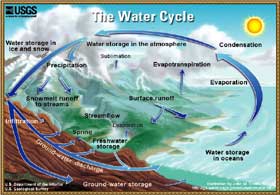 radiation. It changes its states between liquid, solid and gas phases, following the physical processes of evaporation and precipitation which leaves the water in eternal movement.
Precipitation over land is always larger than evaporation, meaning that water available from rivers is secure. In the oceans, the process is inverted, with evaporation always being bigger than rain over them.
The system is flawless until there is human intervention.
Thanks to it, huge resources were damaged like in the Aral Sea, once the fourth biggest lake. Projects to divert the waters that fed it towards cotton farms literally dried it up to 10% of its former size.
In cases like this, human intervention causes irreversible damage, as the area around the Aral Sea is doomed to never recovering again, with scientists desperately trying to find a way out.
Obviously the water does not disappear from the planet but it may become inaccessible for chunks of the population and, in some instances, cause changes in the climate.