Geographical
"Water, water, everywhere..
...but not a drop to drink." (Samuel Taylor Coleridge)
It is scary to hear that less than 0,1% of the world’s water is available to drink. Water is always something so easy to obtain that it is even hard to imagine that all of it should account for such a small fraction.
In countries like Brazil it may actually be difficult to convince that water can be a 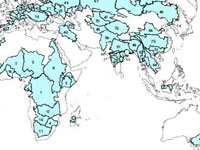 finite resource. It is one of the places with more fresh water available on Earth (right). Almost 15% of all the water resources are located there, especially in the Amazon basin.
“If you pick up all the fresh water available in the world and divide it per person, it is more than enough”, affirms the journalist Adel Darwish, author of the book Water Wars. “The main point is that this water is not equally divided and a part is not easily available, creating a problem to poor countries”, he says.
Mr. Darwish’s observation underlines a situation that most of the people in countries like Brazil cannot even imagine. According to statistics from the World Bank, some 41% of the population of the world (2.3 billion people) live in river basins where the water supply is under 1,700 m³ per year - a number that is considered a “water stress” condition. (click on the map below)
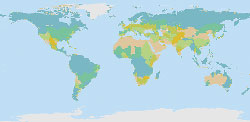 The world today has around 56,000 km³ of renewable water resources. In South America, the Amazon, Paraná and Tocantins basins are the biggest, but the whole continent is washed by many others, producing more than 17,000 km³ of water/year. The loss of forest cover which has happened in recent decades is a serious concern for the authorities, as the forest assured the water kept flowing.
Asia also has vast water resources. Russia alone has almost one third of the yearly 17,000 km³ available in the continent. However, some of the biggest water related tragedies took place in Asia in the last decades, like the South Asian tsunami and the Aral Sea disaster.