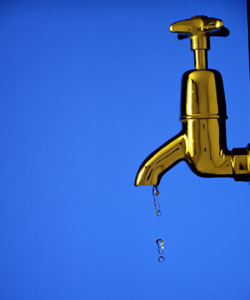
Drought in England
Almost in the same day that water customers read in the newspapers that the profit of water companies had risen to more than £2 billion, they were told that they should close their taps during the coming summer.
They weren’t very happy about it, especially when the news came after the second driest winter in 100 years, and became unhappier still when the British media published figures of the water leakage levels in the country.
In cities like London, almost one third of all the water is wasted through leaks, where the pipe network is old and needing investment.
This is not the first drought that England has ever faced, nor will it be the last. But it is certainly the first one happening amidst global concerns about how the increase of population and global warming will affect water resources.
Companies defend themselves
“We are already facing a drought in the South East of England, even if it is not easy to determine how it can be defined”, said Barrie Clark, a spokesman for Water UK, a body which represents the water companies.
“This is the result of two very dry winters, and there is not much we could have done about it”.
Water UK do not agree that the leakage figures represent a failure of the water industry.
According to Mr. Clark, since privatisation began in the early 90’s, the leakage levels fell by 30% and the prices are agreed by Ofwat, the water watchdog.
“It is Ofwat that set the price limits and not the companies”, said Mr Clarke.
“Then, there is a need to have a return, otherwise the shareholders will take their money out of the business. A reasonable return has to be provided.”
In some cases, the return may be badly needed in the near future.
Thames Water, the supplier for London area, has been under severe pressure to improve its figures and can receive fines from Ofwat of up to £100 million, some 10% of its total turnover.
In the beginning of June, the report of a House of Lords committee criticized the company for both the leakage levels and a continuous flurry of excuses.
“All these excuses don't amount to a very convincing reason to the wider public. They are not meeting targets set by Ofwat and should clearly be fined for it and be put under great economic pressure to get this leakage rate improved”, said the chairman of the committee.
According to the Environment Agency, Thames Water alone wastes around 800 million gallons a day, an amount which could be enough to supply water to another 10 million homes.
Not only leakage…
But the low efficiency of companies like Thames Water is not the only reason for the current drought and it is likely it will be the same scenario for the following ones.
As the population increases, some parts of England are simply running out of water resources, just like many other spots in the world, but certainly without the same seriousness.
Once the gap between demand and supply is closing, the need to better water management becomes greater.
“Technology may not find new ways to transport water, but it can help to manage better the current resources, like diminishing leakage levels and creating better solutions like more economic toilet flushes”, said the journalist Adel Darwish, who is a water expert.
“It can be useful leading to techniques to create new resources, like desalination, for example”, he said.
For Ian Hart, of the Pacific Institute, a great share of attention should be given to global warming, as it can have unpredictable consequences on the world’s climate.
“I think that climate change is the biggest challenge to face in the next years, because it is set to have a huge effect and we hardly can predict what is going to happen”, Mr. Hart said.
…and not only in UK
The UK’s continental neighbours are not in a very different situation.
Spain is preparing to have the worst drought since 1947, as the country’s reservoirs levels have fallen dramatically, hitting hard cities like Valencia, Alicante e Murcia, which rely very much on tourism. As in England, Spain has gone through its second year with a low rainfall level.
Parts of America, Africa and Asia are also going through a shortage of rainfall, but the drought in itself is a phenomenon that has happened many times before.
The question now is: can it become more frequent in the near future?