Environmental
The idea that we’ll have secure water for free forever is dead and buried. Most of the major water resources in the world are damaged to some degree and in some areas the consequences will be felt for another 10 or 20 years. They are felt already and, in some cases, dramatically.
Pollution used to be in everyone’s minds when the subject was damaging water.
Contamination is certainly one of the most hazardous threats to water. Pollution coming from sewage and fertilizers can make large amounts undrinkable. Chemical products in excess can make algae grow more than normal affecting the ecosystem im many ways.
Oil, heavy metals and radioactive substances are dangerous as well, but there are other reasons to be concerned and look after the environmental conditions of water.
One of them is global warming, which has a gradative impact, but can change radically the life conditions in the planet.
“I’d say that dealing with global warming is the most sensitive question because none can know for sure what is going to happen, nor its intensity”, says Ian Hart, from the Pacific Institute.
The past teaches that man-made major disasters are a real possibility.
Aral Sea: a Soviet disaster
The Aral Sea was once the fourth biggest lake in the world. Locked in Central Asia, it was part of the Soviet republics of Kazakhstan and Uzbekistan when the Muscovite central government decided to press ahead with a brilliant idea to irrigate cotton crops in Ukraine.
To do it, the riparians (the rivers which feed a lake or sea) of the Aral Sea (Amu Darya and Syr Darya) would have to be diverted. For Soviet engineers at the end of the 1960’s, the evaporation of the sea was unavoidable anyway.
The result is that the formerly 68,000km² reservoir has already shrunk by 70%. The area has levels of lung cancer, tuberculosis and infant mortality more than 30 times the rates before the project took place.
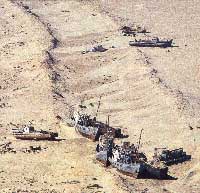 An island which was well isolated in the middle of the Aral Sea, Vozrozhdeniye Island (which means ‘Rebirth’), was chosen by the Soviet government to host experiments with biological weapons precisely because of its eternal isolation.
With the desiccation of the sea, the island has grown and the vast abandoned facilities of the former Soviet laboratories are much closer than they once were.
In 1999, American scientists found live spores of a highly dangerous anthrax spore buried in a pit in the island, where the Soviet scientists had placed them in a supposedly safe site.
The pit, called by The New York Times “the world's largest anthrax burial ground”, used to be quite far into an isolated island, but not for long.
“This was a disgrace”, says the water journalist Adel Darwish. “If the Russians could do absolutely anything to come back in time they would, but unfortunately, they cannot”.
An international program is trying to minimise the impact of the tragedy, planning dams and new diversions of the water courses, but there is little hope of reversing the process.
New geopolitical borders
For the American economist Jeffrey Sachs, the ecological consequences of economic activities will be the fundamental debate of the 21st century.
“Each era has its own dominating themes of global politics. The 19th century had the politics of industrialization and empire. The first half of the 20th century bowed to world wars and economic depression. The second half was overshadowed by the Cold War. Our era, I believe, will be dominated by the geopolitics of sustainability”, he says in the paper “The New Geopolitics”.
Sachs argues that increase in the economic output has been far more positive than the ecological price paid so far.
But he warns: “Yet because many of the environmental consequences of human actions are hidden from view and from our national income accounts, we sit atop ticking ecological time bombs.”
The economist points to a path where global politics look for sustainability solutions and governance to provide a “vital bridge to future prosperity and peace”.