

The nuclear industry creates vast quantities of waste, and as stations begin the decommissioning stage this is set to increase further. What happens to this waste? Where does it go?
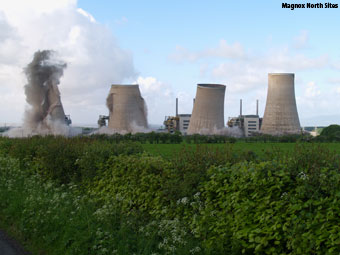 Image of Chappelcross stations cooling towers being demolished
Waste Disposal
Nuclear waste can be divided into three categories, low level waste (LLW), high level waste (HLW) and intermediate level waste (ILW).
LLW, which consists of items which have been contaminated with radioactive material, is currently stored at a facility near Drigg, however, there's a worry that waste will soon outstrip capacity.
Alyson Armeet from the NDA said:"It is close to capacity at the moment, there is more space being created, there is a new vault being built at the moment and there are future plans for expansion but that would be subject to planning permission."
There is currently no long-term solution to HLW, and many believe new stations should not be built until a solution is found.
Reg Illingworth, who runs the Shepperdine Against Nuclear Energy blog said: "We would consider any plus points are far outweighed by the negatives. There would be 160 years of nuclear waste."
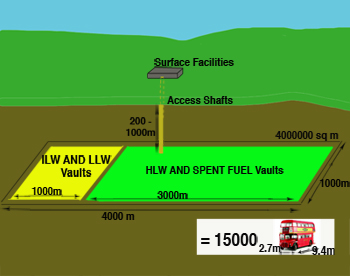 Diagram showing an underground geological depository- not to scale
The latest report from the Committee of Radioactive Waste Management, a government advisory body, believes that an underground repository would provide an effective solution, particularly for the most dangerous HLW and spent fuel.
Richard Shaw from the British Geological Survey said: "There are a number of geological environments that are suitable for radioactive waste disposal. The most important factor is that the groundwater that flows through the host rocks is slow."
The government is currently asking communities to volunteer for a site, and the first being considered is Copeland and Allerdale in Cumbria.
Transportation of Material
To be moved to the current waste disposal sites, reprocessing plants and any future underground sites, nuclear material has to go on a journey by road, rail, sea or air, and every day large shipments travel around the world.
Eva Foren from Direct Rail Services, a company who provide transport for nuclear material said: "The nuclear industry uses rail as the primary mode of transport. The in-built safety systems, that allow the network to operate are ideally suited to the security requirements for moving these types of cargoes."
The enforcement of these safety standards is currently undertaken by the Department for Transport, and takes the UN and IEAE regulations into account.
Tests for containers include two drop tests, a fire test and an immersion test, and are set to test against severe conditions.
However, David Corden from the Nuclear Trains Action Group said: "The test put in place for transportation are not enough because they don't meet the worst case scenario. For example their fire test is heating the flask to 800 degrees for an hour. But if there was an oil fire, they can reach 2000 degrees Celsius and can last for hours. Also the drop test they put in place is from nine metres high but many viaducts are much higher than nine metres."
There is also a concern that nuclear material can be stolen or tampered with during transportation but the World Nuclear Transport Institute says precautions are taken to prevent this.
Betty Bonnardel-Azzarelli from NWTI said: "The main concern in the past was theft and diversion of nuclear material but the tragic events of 11 September 2001 in the USA, have heightened sensitivities to security in face of terrorist action. A range of protection measures have been employed during transport, as deemed appropriate, ranging from the design of the package and the vehicles used as well as security forces, access control, employee screening, satellite tracking of shipments and co-ordination with local and national security authorities."