
The new coalition government has pledged that there will be no subsidies given for new nuclear power plants.
So, how much does nuclear power cost?
Royal Academy of Engineering - 2004
Royal Academy of Engineering (RAE) commissioned by Parsons Brinckerhoff created a study concerned with the costs of generation. It looked at how much each supply technology would cost to generate electricity, measuring the costs in pence per kilowatt hour of electricity:
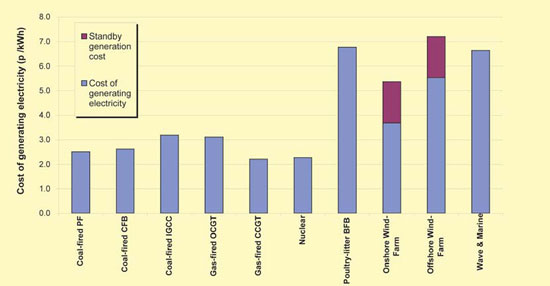
With the exception of nuclear, the analysis assumes that the cost of decommissioning is assumed to equal the scrap value of the plant equipment.
The study looked at how this would change when including carbon emissions costs, and which of the technologies would see cost increases because of this:
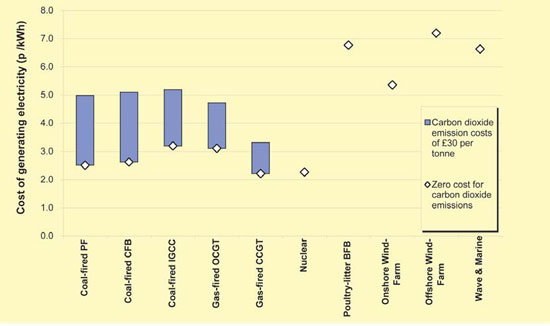
Carbon dioxide emission costs could begin to become a major factor as the government offers more incentives to low carbon technologies.
OXERA Consultancy - 2005
This OXERA report looks specifically at the financing of the nuclear industry in Britain.
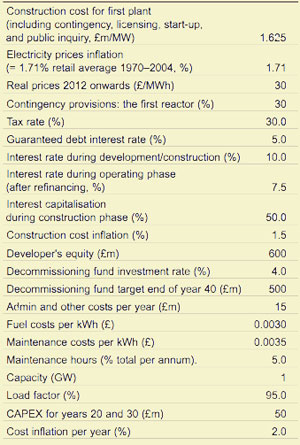
This study states that development costs are the second most important factor in investment in new nuclear, and that construction of new types of plants will have a high degree of financial risk to begin.
The study predicts that there could be "total development costs of as much as £1.6 billion for the first reactor, decreasing to £1.15 billion for subsequent reactors"
The chart opposite states key assumptions for the base rate predicted in the report.
The report concludes there is potential for investment in nuclear power to bring positive returns but questions whether this is sufficient for private investors to foot the bill without public assistance.
Parsons Brinckerhoff
Parsons Brinckerhoff has updated the RAE reports across several years in 2006, 2008 and 2010. The 2010 study shows the latest estimates made about the costs of electricity generation, once again looking at pence per kilowatt hour of generation:
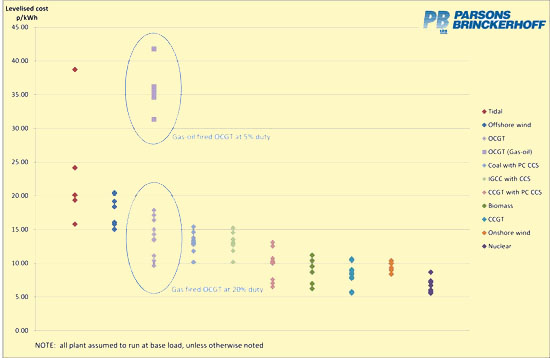
There were some major changes between the 2004-2010 studies. It removed those plants which were either no longer permitted to be used or which were no longer considered likely.
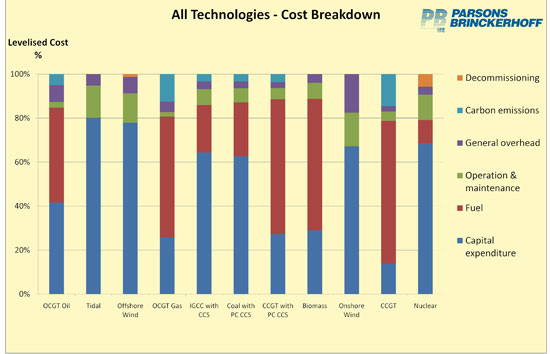
The study also hoped to break down the variations of capital and fuel price between differing plants:
Costs breakdown help to show what aspects of the production could cause prices to rise. In nuclear a huge percentage of the overall costs come from the construction of the plant itself. This is why the costs have been seen to rapidly increase in past builds, when construction is delayed.
There have also been studies looking at nuclear power generation worldwide, which compare the costs of nuclear world-wide.
World Nuclear Association
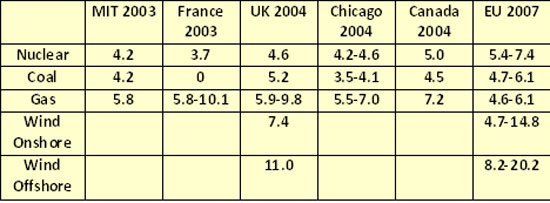
The World Nuclear Association report examined different studies undertaken across the world examining nuclear power, and placed them together in order to compare the differing assumptions: Its comparison chart is listed below.