
The move from fission to fusion
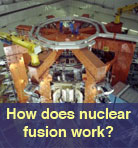
At the Culham Centre for Fusion Energy (CCFE) work is underway looking at how nuclear fusion could be used for future energy production.
The centre operates two tokamaks, the device used to achieve fusion, the largest of which is the Joint European Tokamak (JET).
Dr Andrew Davis from CCFE said: "Jet operates at temperatures in excess of 150 million degrees Celsius... Jet is the world's largest and most powerful tokamak producing its record of 16 megawatts of power in 1991."
The next step in nuclear fusion is ITER, which is a world-wide project and will produce around 500 megawatts of power for 400 seconds. This will be a step closer to producing a full fusion power station.
Fission or Fusion?
Fission |
Fusion |
About 35,000 tonnes of uranium is mined per year, but a lot of the market is being supplied from secondary sources such as stockpiles. |
Deuterium can be extracted from water and tritium is produced from lithium, which is found in the earth's crust. Fuel supplies will therefore last for tens of thousands of years. |
Britain already has more than 100,000 tonnes of higher activity radioactive waste that needs to be stored, some of which will remain radioactive and hazardous for hundreds of thousands of years. No solution has been found for higher levels of waste. The most likely plan is underground storage. |
Only plant components become radioactive and will be safe to recycle or dispose of within 100 years. |
Nuclear power plants do not release greenhouse gases. Without nuclear power stations, UK carbon emissions would be 5% to 12% higher. |
The only by-product of fusion reactions is helium, which is an inert gas that will not add to atmospheric pollution. |
A conventional nuclear fission reactor produces between 1000 MW and 1600 MW of energy. |
One kilogram of fusion fuel can provide the same amount of energy as 10 million kilograms of fossil fuel. A single laptop battery in half a bath tub of water will provide enough power from fusion for 30 years. |
Chernobyl, Wind Scale and Three Mile Island are a reminder of the accidents which can occur in nuclear fission. However, modern reactors are designed to shut down in the event of an accident occurring. |
The small amounts of fuel used in fusion devices means that a large-scale nuclear accident is not possible. |
Fission power plants should provide a baseload, supply, at costs that are estimated to be broadly similar to other energy sources. |
Fusion power plants should provide a baseload supply, at costs that are estimated to be broadly similar to other energy sources. |
Fission is already a developed source of energy production, and the methods are currently in use. |
International fusion is currently working towards providing energy in the next 30 years. |