BARTER IS SMARTER
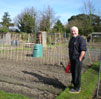
Either cash is drying up or solidarity is in the air as more and more people are now joining trading schemes. In the UK, 100 000 Britons are members of Local Exchange Trading System (Lets), Time banks or Time Banking to save money on smaller jobs.
The concept is rather simple: members of a community exchange goods and services without money. If one offers to paint another member’s kitchen, he can then trade for gardening, in turn for cooking, DIY, or dog-walking, etc.
“It’s barter but not straight for straight,” explains Mary Fee, secretary of Letslink UK.
The cost is time, not money. Although, Lets members set a value for a service in an invented currency —“readies” in Reading, Concrete Cows (CCs) in Milton Keynes, Wadevas (WADS) in Derby... — while time banks deal exclusively in time: an hour of work is worth any other one.
And it seems to be useful for people during these difficult financial times.
However, as Lets are run by members and exist as friendship networks as much as alternative economies, some work better than others. “There are 300 Lets or so in the UK, but as nobody pays for the research, we don’t know how many are functioning well,” says Fee.
Fee is trying to fill out the map by bringing in a county system. She hopes that by centralising the information under an interactive platform that regroups all the Lets in the UK, young people would be tempted to join.
“We constantly need people to carry on trading so the scheme survive."
“It’s a bit like gardening, it’s quite a delicate matter keeping a Lets going, if you don’t look after your scheme, the weeds would grow.”
Time banks are much more structured. They are funded by outside agencies and have staff.
“It’s a way to make volunteering easier,” says Laura Hurley from Time Banks. “Big companies like Sony give their staff five days volunteering a year. And we arrange charity projects for them.”
'IDEAS TO LIVE BY'
A new school within the University of London campus offers to help people to adapt their lifestyle to modern pressure. The crisis gave it a dramatic relevance as people are more looking for answers to cope with it.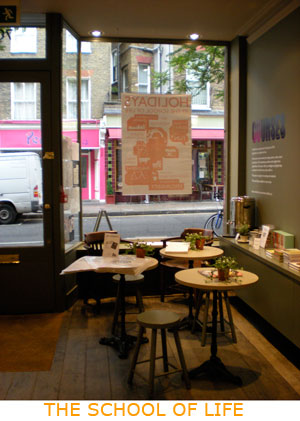
Philosophical and practical, The School of Life, based in Marchmont Street in London, proposes “ideas to live by” that will disrupt the principles that usually guide our choices.
Sophie Howarth, a former Tate Museum curator who is now director of the philosophical School of Life created an educational programme that are taught by well-known writers, journalists, philosophers and artists including De Botton, Martin Parr or Roman Krznaric.
"The School of Life is about the practical application of philosophy on life’s core subjects – love, politics, work, family and play," explains Howarth.
"The courses are structured around the burning questions that keep you awake at night – how important is sex or what’s so great about democracy? We’re rooted in the big thinkers, but always at the service of 'how will this be useful to me?' "“Adult education doesn’t have to be dowdy." Sophie Howarth
Howarth spent 12 months preparing the different programmes. Each course are spread over six evening classes for six weeks. But intensive weekends have also been designed so people rediscover places they live nearby with a new angle. The aim is not to escape from the day-to-day live but to learn to live creatively and intensively every day.
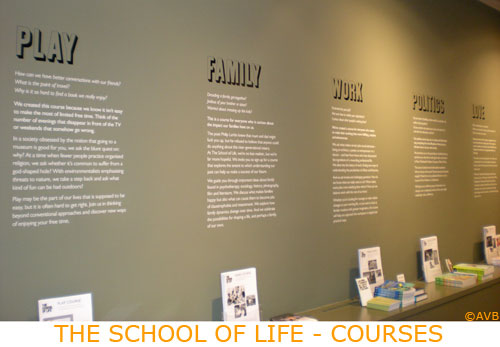 Angharad Davies from The School of Life says: "There are 20 places in each course and every time we are completely booked.
“People may have changed their priorities with the recession and seem to be more inclined to think about what’s important in life”.
Since the credit crunch has hit Europe, the workshop ‘work’ has been the busiest. “I assume it is because people are losing their job or think that they will lose their job that such introspection occurred,” says Davies.
The school is open to anyone who is willing to pay the price of education: £195 for six lectures. Although, there is no membership, “people just sign in for the course they are interested,” continues Davies.
But Howarth assured that they are “maverick but we’re not trivial, and we’re not taking any risks about whether it is any good. Otherwise you’re just selling hot air in a fancy shop.”
The School of Life, 70 Marchmont Street, WC1N, LONDON.
LINKS