'Britain at the rear' for bee research
by Simon Essex
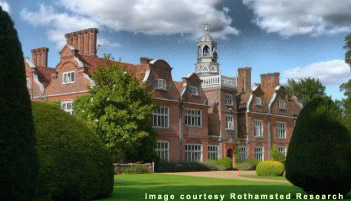
Rothamsted's bee unit was closed
Bee experts say the government made a big mistake when it stopped funding one of the world's leading bee research unit.
Rothamsted’s honey bee unit had to shut down in 2006. Tthe government’s National Bee Unit is now the primary centre responsible for bee studies and disease diagnosis.
Rothamsted experimental station was one of the leading institutes for honey bee research, and remains the oldest agricultural research station in the world. Britain’s top bee scientists worked on research and cures for bee diseases and parasites.
Possible solution
Norman Carreck is very concerned about the varroa mite (see boxout: Varroa Mite). One of the honey bee’s worst enemies; it is now resistant to Apistan - one of the main miticides sold to kill it.
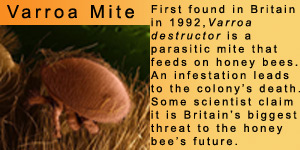 Mr Carreck was developing a potentially breakthrough solution to the problem at Rothamsted: “We were working on a promising fungus that would kill varroa without affecting the honey bee, but needed more money for another three years.”
But there was no more money. In 2006 Defra stopped funding for honey bee research at Rothamsted. It could not afford to keep Mr Carreck and other apiculture scientists in employment.
Dr Juliet Osborne is still at Rothamsted, where she studies bumblebees. She says that the departure of Mr Carreck and his colleagues was a great loss, but one that Rothamsted could not prevent without government help: “We’d had bee disease work at Rothamsted for a hundred years at least. In the last 20 years, all funding for this was from Defra. When they decided to stop funding the whole unit, it was impossible for Rothamsted to take up the slack.”
“Norman was working on a fungal pathogen to deal with Varroa. It was very frustrating for us all. Now the research is at a stage where Defra won’t fund it.”
Sometimes scientists can obtain funding from chemical companies for their projects, but this was not possible for Mr Carreck: “The product was at a stage where it was too far from being a commercial product and needed more money from the government.
“We’d wasted two years work. Now look at the situation: just at the time that project would have been very useful, the work ground to a halt.”
National Bee Unit
Mike Brown is head of the National Bee Unit (NBU), which runs from the government’s Central Science Laboratory in York. After Rothamsted’s closure, it is the only major honey bee research station in Britain .
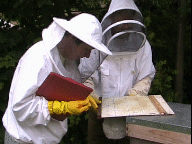
Beekeepers searching hive for varroa.
Dr Osborne says the NBU does not have time or money for research: “Most of the work of the NBU is diagnosis of disease, not the prevention of it or management of the bees.”
When asked about continuing research into Mr Carreck’s fungal solution for Varroa mites, Mr Brown says: “No, we are not working on that one; I don’t think we need to do that. Besides, France and New Zealand are working on it.”
For Dr Osborne, this is not satisfactory: “Of course they are strapped for resources, but they feel they can rely on research results from other countries. They can’t; the situation in Britain is different to anywhere else.”
Without Rothamsted sharing in-depth research and projects Mr Brown admits that research is difficult: “It is pretty hard to keep things going. We worked closely with Rothamsted.”
Future research in Britain

Britain has gone "from the forefront of bee research to the rear" - Tim Lovett
London beekeeper John Chapple says: "We had one of the world's best research centres for bees and the government closed it down. I wouldn't say they had all the answers, but they were going down the right line."
In response, Defra Minister of State Lord Rooker denies that the government is responsible for Rothamsted closing its honey bee unit: “The closure of Rothamsted’s bee unit was a matter for Rothamsted; it was not an issue of Defra funding, although obviously we use the centre for research.
“Although there is no longer a team working on bee pathology at Rothamsted, apparently a group of researchers still studies bee behaviour, pollination and conservation.
“To the best of my knowledge, we are not short of bee research.”
For Dr Osborne, this means there is little hope that Mr Carreck will return or the bee unit will re-open: “I’m not holding my breath that Defra will come up with more money, or soon.”
What do Defra have to say about Rothamsted and funding for bee research? And what are other MPs saying about the bee situation? Click here to find out.


