Claims that bees brains affected by pesticides
by Simon Essex
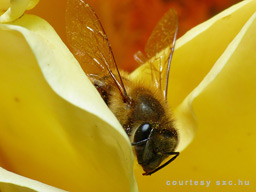
PAN UK say some pesticides may be harming bees
The Pesticides Action Network (PAN UK) claim that neonicotinoid (neonic) pesticides (see boxout: Neonic Pesticides) are interfering with a bee’s brain, impairing its memory and ability to find its way back to the hive.
PAN UK's information officer Ruth Beckmann says that a bee's nervous system is being affected by visiting crops that have been treated with pesticides: “The bees are receiving sub-lethal doses. As a result they are getting chronic problems rather than acute poisoning which would kill off the bees directly.”
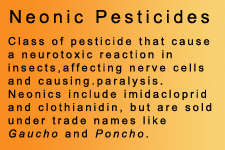
Although crops are not sprayed with these pesticides, it is ‘painted’ on to seeds before they are planted. PAN UK says these pesticides then persist and spread to the root and flower of a crop. This is known as a systemic reaction.
Journalist Michael Schacker has been investigating honey bee losses in America and thinks there is a link to pesticide use: “Mainly, the poison intoxicates them so they can no longer navigate back to the hive or cripples them so they cannot communicate the directions to the nectar sources.”
According to figures released by the London Beekeepers Association, imidacloprid (IMD) is used as seed dressings on oilseed rape, sugar beets, linseed and cereals. IMD is a neonic pesticide that is also applied to lawns and golf courses. Mr Schacker says that this adds up to over 1.5million acres of land: “If IMD is the culprit that would appear to be enough IMD-applied acres to cause widespread colony collapse disorder in England.”

Michael Schacker
In Europe, Germany has banned the use of the neonic pesticide Poncho, made by Bayer CropScience, following an incident where its misapplication caused the deaths of millions of honey bees. In Britain, Poncho - the same chemical now banned in Germany – is used on sugar beet crops.
Ms Beckmann says that there should be more studies done on pesticides in Britain: “There are no reports or research in the UK . If there’s research to back the theory up in Germany and France then there’s no reason to think that the situation would be any different over here.”
Phillip Mimkes from the Coalition Against Bayer Dangers in Germany says that research into neonic pesticides is not needed because they should be banned: "We have been pointing out the risks of neonicotinoids for almost 10 years now. These pesticides shouldn't be on the market."
 Bayer CropScience is the second largest agrochemical company in the world, and the biggest supplier of pesticides to Britain . What do they have to say? Click to listen to an exclusive interactive interview with Bayer’s Dr Julian Little.


