Stonewall: Changing times
By Navaniita Dhar | 07.06.2006
Stonewall….
Stonewall is a name which cannot be ignored if someone is dealing with the lesbian, gay and bi-sexual community in Britain.
Established in 1989, Stonewall's aim was to prevent attacks on lesbians, gay men and bisexuals. The organisation's journey from 1989 to 2006 has been a struggle to uphold its aim to achieve equality and justice for the LGB (lesbians, gay and bisexual) community.
Initially founded by a handful of men and women who had been active in the struggle against the Section 28 of the Local Government Act, Stonewall was determined to create a ‘professional lobbying group’ that would prevent such attacks on lesbian, gay and bisexual people.
Section 28 of the Local Government Act was an ‘offensive piece of legislation’, according to Stonewall. The Act was designed to prevent promotion of homosexuality in school.
Communication officer of Stonewall, Mr Andy Forrest, points out that it's not only the Section 28 of the Local Government Act that the organisation has fought against, there are many more which Stonewall has campaigned against.
“Some of our major successes were achieving the equalisation of the age of consent, lifting the ban on lesbians and gay men serving in the military, securing legislation allowing same-sex couples to adopt and the repeal of Section 28. Securing civil partnership rights and ensuring that the Equality Act protects lesbians and gay men in terms of goods and services, can be included in our recent success list.”
Is it only about success?
The achievements of Stonewall are obviously outstanding, but some incidents in the past and even in recent times show that it's not really easy to ensure equality and justice for the lesbian, gay and bisexual people.
Mr Andy Forrest says: “It is true that we have come a long way but there is still a lot to do. We have moved from changing laws to changing attitudes through our projects, but still there are prejudices which lead to tragic and appalling incidents.”
Incidents like the bombing of Admiral Duncan pub in Old Compton Street (April 1999) in London, and more recently the murder of south London barman, Jody Dobrowski, is a constant reminder of the presence of violent crime against lesbians, gay men and bisexuals.
“There are still places where people are beaten and killed due to their sexual orientation. We have had incidents like that in London. But we are happy that things are getting better and our voice is heard”, Mr Forrest added.
Some incidents…..
In the recent past, London has witnessed ‘hate crimes’ against the lesbians, gay men, and bisexuals. These incidents have reminded us of the existence of homophobia in our society.
Bombing of Admiral Duncan pub
The Admiral Duncan is a pub in Old Compton Street, in the heart of London's gay district, Soho.
On April 30,1999, it became the scene of a bomb blast when David Copeland, as part of a series of bombings against gay people and ethnic minorities, detonated a nailbomb which killed three people, including a pregnant woman and wounded around 70.
Mr John Eko, a pub goer, who visits the Admiral Duncan, sometimes feels that it is much safer now for the LGBT people in Soho.
“There are a lot of incidents that still happen but things have changed a lot for the lesbian, gay, bisexual and transgendered people as the society has become more open”, he said.
Murder of Jody Dobrowski
On the 14th of October 2005, Jody Dobrowski, a 24-year old assistant bar manager was murdered on Clapham Common in south London. Jody was beaten to death with punches and kicks by two men who percieved him to be gay, and who had attacked men previously on Clapham Common.
The two men, Thomas Pickford, 26, and Scott Walker, 33, were jailed for life on June 16, 2006, at the Old Bailey for the homophobic murder.
What next…?
According to Stonewall, the British law has changed a lot to become more LGB(lesbian, gay and bisexual) friendly in the last seven years.
Mr Forrest said that though the LGB community has gained more legal right, it’s the attitude of the people that they have to change so that the society becomes more excepting.
“We have seen that rural areas are more prejudiced than the cities and that is due to the isolation and ignorance. We plan to make people aware about LGB (lesbian, gay and bisexual) issues so that the attitude changes and this task can be very hard.”
Awareness...
To raise awareness about lesbians, gay men and bisexuals, Stonewall has launched a campaign in January 2005. The campaign is called ‘Education for all’ and it aims to tackle homophobia and homophobic bullying in schools and works with a wide coalition of groups.
It also plans to raise public awareness in terms of civil partnership, through guides like ‘Get Hitched’. Stonewall is also trying to include transgender issues in its recent activities. A new research on how gay people are portrayed by the media is also on the card.
Related Links:
Stonewall: http://www.stonewall.org.uk
Admiral duncan Bombing:
http://news.bbc.co.uk
Sexuality and gender laws worldwide::
http://www.lib.uchicago.edul
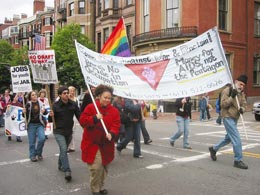
Stonewall activists campaigning for the lesbian, gay and bisexual people's cause.
The Admiral Duncan Club seven years after the bombing.
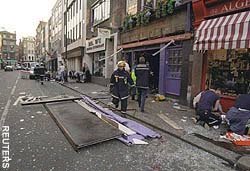
The Admiral Duncan Club soon after the bombing. (courtesy- Reuters and Stonewall)