
| About |
| GI Diet special report |
| Celebrity diets |
| Diet digest |
| GI diet diary |
Atkins lifespan |
| Contact us |
| Useful
links: |
| BBC article: Girls diet for pop star bodies |
| Related Telegraph article |
Celebrity
fad diets
Feature
Take one celebrity on the latest diet. Add a dash of radical
weight loss claims. Place on a large shelf in all major retail outlets.
Serve with plenty of sassy photography on a wide plate of press coverage.
An estimated 12.8 million Britons are dieting at any given moment, 60% of whom are on a programme with a medical or celebrity endorsement. The covers of many women’s magazines carry messages such as ‘Liz Hurley’s secret to staying slim, how Renee Zellweger returned to a size 6 after filming Bridget Jones Diary.’
The revelations come
thick, fast, weekly. They are often conflicting and confusing. Geri
Halliwell is said to up the Atkins Diet and becomes thin overnight.
Celebrities reinvent their diet plans as often as they reinvent their
own image.
Low self-esteem
In a recent article in Campaign magazine, Professor Susie
Orbach, wrote: “Just half an hour looking at a magazine targeted
at youngsters could drop their self-esteem significantly. One in four
college females has a serious eating problem and most women wake up
and feel their tummies to check how good or bad they’ve been
the day before. That’s before they’ve even brushed their
teeth, their critical selves are planning how punishing to be today.”
In a recent survey conducted for the Norwich Union Healthcare nutritional health report, 85% of GP’s rated their patients’ eating habits as unhealthy and the same figure believed this was a result of diets popularised by celebrities.
Dieticians and nutritionists
are also increasingly concerned.
Doctor Frankie Phillips, a registered dietician for the British Dietetic
Association said: “Just because a diet works for Carol Vorderman
it doesn’t mean it will work for everybody. Most 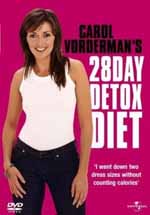 celebrity
diets are extreme. It simply isn’t realistic that someone who
is 18 stone is going
to be able to look like Kylie Minogue. Many celebrities have personal
trainers and spend a lot of money on their diets and this is not possible
for most ordinary people.”
Carol Vordeman
28 Day Detox Diet
And it’s not just
the diets that are unrealistic. According to Jim Pratt, art director
for FHM men’s magazine, a lot of what we see literally isn’t
there: “Nearly all of the images of celebrities and glamour
girls are airbrushed to make them look younger, thinner and to remove
imperfections. Most celebrity agents refuse to release imperfect photographs.
This is standard practice throughout the industry.”
Yet not everybody is in agreement that celebrity diets are bad for our health. Pat Wilson, member’s service manager for Weight Loss Resources, said: “Slim and healthy role models such as Kate Winslet can offer inspiration. People who are overweight experience serious health problems and it is important that this message gets across in the media.”
 Marjorie
Burte, a former regional manager for the Atkins Diet, said: “We
did not set out to attract personalities such as Jennifer Anniston,
they discovered the diet for themselves and then publicised their
personal weigh loss success because they were pleased with the results.”
Jennifer Anniston
But Professor Orbach
remains skeptical: "I think it is easy to underestimate the power
of culture, particularly pictorial culture which is driven by industries
that gain a lot from 'destabilising' girls and women's sense of self."
At the recent Body Image Summit held by Tessa Jowell, Minister for
culture, media and sport, the Social Issues Research Centre called
for the introduction of regulation
preventing the diet industry from creating unfounded anxiety about
weight and promoting dieting as 'healthy’. But according to
the Press Complaints Commission, responsibility ultimately lies with
consumers and editors. Jonathan Falcone, a spokesperson for the PCC,
said: “I’ve never known of a complaint against an article
on dieting. If a diet claim is inaccurate and a complaint is brought
forward we would deal with it on an individual basis.”
Not all magazines jump on the scales the minute the latest diet is released. Emma Hoddinott, from Bliss magazine, said: “Under our new editor, we have scrapped all diet features and even when we had them, we promoted healthy eating and exercise above weight loss. We ran a 'love your body' campaign to try and get teens thinking positively about their bodies. I don't think that magazines cause eating disorders, but they have promoted the message that skinny is good with their support of super slim celebrities.”
Antonia Kanczula, from Health Plus magazine, agrees: “We do not support or write about celebrity diets. We covered the GI Diet because it is linked to the prevention of diabetes and is not a typical fad diet. Our readers are intelligent enough to draw their own conclusions because we teach them about healthy eating.”
Lucy Smith, a manager from London, thinks consumers deserve a bit of credit: “I enjoy reading about celebrity diets but it’s just a bit of fun and gossip. I might try one out for a couple of days but then I forget about it. Everyone knows magazines write a load of crap half the time.”
 Not
all diets endorsed by celebrities promote radical promises or claim
we should all be a size ten. In the past year we’ve seen chef
Jamie Oliver revolutionise school dinners, celebrity nutritionist
Gillian McKeith help overweight adults and witnessed Morgan
Spurlock’s near death experience in proving that McDonalds
food is bad for us.
Dr Gillian McKeith, You are what you eat
Dr Andrew Hill, senior
lecturer in the Academic Unit of Psychiatry and Behavioural Sciences
at Leeds University School of Medicine, thinks that these celebrities
send a positive message: “They have identified the lack of skills we have towards food
because it’s no longer being taught in the family home. They
use their personality status to re-teach us how to eat which is a
move away from what has become a sort of cooking pornography whereby
eating is not seen as a natural or enjoyable activity but is broken
down into its scientific parts.”
He also points out that the diet industry
does not represent the millions of us who quietly and successfully
manage our weight, because this does not make for grabbing headlines:
“Diet publicity subscribes to the same market forces used to
promote a record or a car. They need to make as much money as quickly
as possible because they know they will be replaced by the next big
thing. In a celebrity obsessed and consumerist society, exceptional
people are a vehicle to make money.”
--------------------------------------------------------------------------------------------------------------