The disappearing act
It is nearly sixty years since Sir Edmund Hillary placed his foot on the summit of Mount Everest, becoming the first man to stand on top of the world. Since then, thousands have travelled from far and wide to pay homage to one of nature’s great marvels, and to witness the iconic snow-topped peaks of the highest mountain range on the planet.
Although ‘Himalaya’ translates to ‘snow mountain,’ scientific evidence suggests receding glaciers are threatening to make the name but a haunting memory. For 1/6th of the world’s population living in Northern India, Pakistan, Bhutan, parts of China, Bangladesh, Cambodia and Vietnam whose lives depend on the fresh water from the mountains, a potential catastrophic change is looming ever closer.
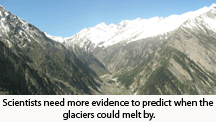
However, through a lack of substantial scientific evidence, it is hard to distinguish continuing trends that could signify an increased reduction of glaciers.
In the latest report from the World Glacier Monitoring Service (WGMS), it stated, “in terms of front variation and mass balance observations, the Himalayas are strongly underrepresented.”
The WGMS, whose backers include UN agencies and scientific bodies, collects annual data for up to 100 glaciers around the world, including 30 "reference" glaciers in nine different mountain ranges on four continents, for which data goes back nearly three decades.
Michael Zemp, director of WGMS, said, “From recent studies and the few in-situ observation series on Indian glaciers reported to our service…it is obvious that the general trend of centennial glacier retreat is also apparent in the Indian Himalayas.”
The latest data from The Energy and Resources Institute (TERI) in New Delhi shows that in the past four decades the Kolahoi glacier in Kashmir has lost between 15 to 18 percent of its total volume. The research also shows that the glacier is retreating by almost three metres a year. This example alone, however, cannot prove that all glaciers are receding.
Dr Shakil Romshoo, a glaciologist and professor at Kashmir University, says, “Even if glaciers are in the same climate and demographic this does not mean they are all reacting the same to the temperature increase.”
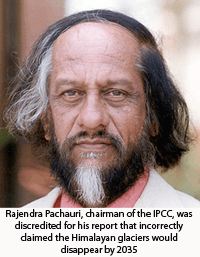 Controversy surrounding whether glaciers are melting faster due to climate change has been topic for serious debate since the International Panel on Climate Change was discredited this year for it’s 2007 report claiming the Himalayan glaciers will completely disappear by 2035. Although this report is now widely acknowledged to be incorrect due to a lack of sufficient scientific evidence, many scientists continue to promote the argument that manmade climate change are accelerating the rate glaciers are melting.
Dr Shresth Tayal, a glaciologist with TERI, said, “A vague link can be established based on various research publications by…Indian scientists...But, extensive field data availability is the main constraint in establishing the definite link between climate change and the rate the glaciers are melting.
“Moreover, Himalayan glaciers are naturally vulnerable to heat due to their location closer to tropic of cancer and various other factors. Climate change is just an additive factor in enhancing the melt rate of these glaciers and making their state as pathetic,” he added.
The counter argument to manmade climate change affecting the rate glaciers are receding is that some of the melting is a delayed response to the natural warming of three or four centuries ago, the residue of the ice age.
Fred Pearce, environment correspondent for the New Scientist, said, “If this was the case then melting would have diminished by now but that isn’t what we’re seeing, in fact it’s becoming more intense. This is good evidence to suggest that what’s happening is caused by manmade climate change.”
In November last year, in response to the IPCC’s report, Jairam Ramesh, India’s Environmental minister endorsed a report by geologist Vijay Kumar Raina that claimed there was no evidence climate change had caused an “abnormal” or “alarming” shrinking of Himalayan glaciers and that some had even been advancing. Ramesh told The Guardian, "There is no conclusive scientific evidence to link global warming with what is happening in the Himalayan glaciers."
Dr Romshoo, disagreed with Ramesh, he said, “The indicators of climate change are very loud and clear, all the glaciers are responding to the rise in temperature.”
Dr Shresh Tayal, also rejected the report, he said, “The conclusions drawn in the report do not represent the data presented in the report. A simple analysis of the data [in the report] itself indicates an increase of 200 to 400% in the melting of glaciers in Eastern Himalaya from 2000 to 2005.
“Also, the field photos in the report are not considered scientific evidence for deriving any conclusion. Even a slight change in quality of camera, quality of lens, angle of photo taken can reflect different characteristics,” he added.
Jigmal Tukpa, environment and forest minister in Ladakh, India, said, “Once we have clear scientific evidence then we can decide whether climate change exists. Before then, no one can say it is definitely affecting the Himalayan glaciers.”
Scientist, Etienne Berthier, who studied the thickness of glaciers in the Western Himalayas found in his 2007 report a loss of 0.8 metres of water equivalent per year between 1994 and 2004, which was twice the rate as between 1977 and 1999. If this study is considered next to the Indian Meteorological Agency’s announcement that temperatures in Himalayan regions have risen by over 1°C in the last two decades, then it could be claimed climate change is linked to the pace glaciers are receding by.
 The severity of the melting glaciers is not only that of future water scarcity, directly affecting drinking water and crop irrigation, but lives could also be at risk if a glacier disintegrates above a village.
In April this year, part of a glacier in the Peruvian Andes broke off and fell into a lake, causing a 23 metre tsunami that killed three people.
The WGMS’s report voiced concern that the same could happen in areas of the Himalayas, it said “the number of hazardous glaciers, where outburst floods endangers human life and resources, is rising.”
Fred Pearce said, “If there is water held in a lake then this could potentially be very dangerous because if either the pressure of water breaks the natural damn or the lake overflows, large volumes of water could flow down valley quickly and unexpectedly.
“ The more melting which occurs, the bigger the risks are,” he added.
blog comments powered by DisqusClick here to read about the controversy surrounding the cause of climate change.