Suicidal consequences of climate change?
June 16, 2010
More farmers might commit suicide as crops fail due to changes in climate, one environmentalist has claimed.
In India, approximately 200,000 farmers have taken their own lives since 1997.
Vandana Shiva, environmentalist and director of Navdanya, an NGO that promotes organic farming, said, “Farmer suicides are the most tragic and dramatic symptom of the crisis of survival faced by Indian peasants.”
Many studies have associated the increase in farmer suicides with huge debts. Often, the farmer will take out a high-interest loan from a local moneylender and when their crops they slowly slip into more debt until they can’t see a way out. Navdanya are rallying against the biopiracy of climate resistant crops in a new campaign.
Dr. Shiva said, “Climate resistant traits are found in many crops conventionally grown across the world; these crops are traditionally bred by farmers. The seed multinationals are robbing the farmers of this traditional knowledge and patenting the traits.”
In a report by Navandya, they recorded 530 patents taken on climate resistant traits evolved by farmers by multinational companies such as BASF and Monsanto.
However, Ingrid Nienaber, senior manager of media relations at BASF, said, "To patent a crop it needs to have a newly invented genetically modified (GM) trait, it's impossible to patent an existing design.
"I don't know why the NGO is claiming we have patented traits designed by farmers. People have very different motives towards GM organisms, perhaps there is a concern farmers will become more dependent on multinational companies.
Ronnie Cummins, director for the Organic Consumers Association, said, "These genetically engineered "climate resistant" crops are a dangerous hoax [that are] designed to bolster the profits of patent holders."
He added that the seeds cultivated according to traditional organic practices are "far superior" in surviving drought and torrential downpours.
Mrs. Nienaber said, "Whether it originates from organic crops or GMO, the main thing is finding a solution and finding the highest yielding crop."
By patenting the seeds, farmers will have to pay for seeds. If farmers cannot afford the seeds, they will grow crops that are not resilient to the changes in climate and are likely to fail.
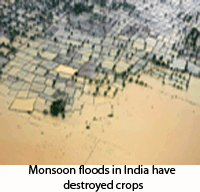
The weather in India has drastically altered the cropping calender and farmers are finding crops are being starved due to drought or their fields waterlogged due to heavy rainfall.
Vinuta Gopal, energy and climate change campaigner for Greenpeace, said, “India has experienced a number of extreme weather events in the immediate past. Last year we had a disastrous monsoon, with flooding and drought across many parts of the country.
“While one cannot say that each of these events was a sign of global warming alone, it is certainly indicative of the kind of extreme weather events we are likely to see more of and with more severity,” she added.
blog comments powered by Disqus