What are the causes behind teenage pregnancy?
 There is not just one reason behind the high rate of teenage pregnancy in Dorset (27.9 per 1000 women aged 15-17), but on the contrary, many issues seem to be linked to it.
A lack of knowledge about contraception is it seems one of the highest reasons for teenage conceptions. In fact Chris Hilder, Sexual Health Advisor for Poole and Bournemouth, says half of teenagers don’t use protection for their first sexual experience. Chris, a former nurse, won an award last year for advising young girls on regular contraception after they visited their pharmacists for the morning after pill: “50% of the girls who asked for emergency contraception had not used any form of contraception whatsoever”.
Katie, 20, from Poole, had James 7 months ago, and admits it was an unplanned pregnancy : “We weren’t using protection so it was purely our own fault”.
But England is also the European country with the highest rate of binge drinking, and alcohol is closely linked to sexual inhibition. Steve Bick, GP in Weymouth and PPC for West Dorset for the Labour Party, wrote an article and implemented a public consultation on teenage binge drinking.
“I think there is a real problem with binge drinking in Dorset […] I think as well someone who’s intoxicated will be less likely to be sensible to contraception so more likely to get pregnant”, he says.
Claire Shiels, Dorset County Council Acting Commissioning Manager for Teenage Pregnancy, agrees a majority of teens had their first sex under the influence and that “80% of those […] say they regret it”.
"It’s when they start drinking that there’s a problem."
In fact, the increase of alcohol consumption and the increase of teenage pregnancy in recent years don’t seem to be a coincidence, according to Annette Brooke, Lib-Dem MP for Mid-Dorset and North Poole and Spokesperson for Children, Young People and Families.
“There is the excessive alcohol, and I think I see a slight change, looking back over the years that I can think of my own daughters, when they went out, they looked after each other, and I think it does still happen sometimes, when girls go out in a group they look after each other, but it’s when they start drinking that there’s a problem.”
 But is a shift in society also to blame? Chris Hilder thinks that with magazines and reality shows for example, the media are getting the message across to young people that it is ok to have sex early, without looking “at the outcomes of having an STI or an unplanned pregnancy”.
She adds they are “physically mature but it doesn’t mean to say they’re emotionally mature”. Young people even get the impression that everyone is having sex, even though only a third of under 16 year olds are sexually active, says Claire Shiels.
When one looks at the case of teenagers who willingly have children, their backgroung plays a crucial part. Mary Kourik, who works at the Connexions Centre in Poole says a lot of the teenagers she works with make the conscious decision to have children: “Some of them are on their second, third pregnancies as well”. “You tend to follow your parents.”
As for the reasons behind this choice, most experts agree that young people with no aspirations, whose parents had them at a young age or who have been brought up in care are more likely to become young parents.
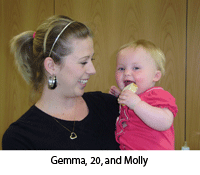
Gemma, 20, who had daughter Molly at 18, says : “[my mum] did have a child at 18 so yeah there is a similarity there”.
“You tend to follow your parents” points out Steve Bick, with Claire Shiels adding : “There seems to be a bit of a cycle that goes on so if your mum’s a teenage parent you’re likely to go on and be a teenage parent yourself”.
Kerri, 19, mother to Thomas, 10 months old, says her mother and sister had babies at the age of 17.
Teenagers that have been raised in care are likely to have babies too, as they know the baby will love them and not leave them. Claire Shiels underlines the fact that “leaving care they quite often want to have a baby because they want somebody to love them”.
And teens with low aspiration sometimes chose to have a child because they think they will not succeed at university.“We’ll never get everything a 100% right." “There’s no aspiration to move on to higher education and that seems like the right thing to do and it seems like a valid option” declares Claire Shiels.
All these different reasons to have babies, whether by choice or not, make the problem more difficult to tackle and that’s why teenage pregnancy co-ordinators have their work cut out for them. “We’ll never get everything a 100% right. Loads of work to do and we can only get better”, Ms Shiels concludes.
EXCLUSIVE
Is teen pregnancy genetic?
Professor Dye, of the World Health organisation, speaks of the genetic basis of teenage pregnancy
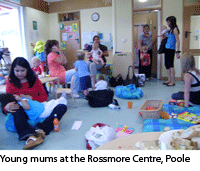
Of six young mums interviewed at the Rossmore Children Centre in Poole, four of them admitted their mothers had them at a young age too.
While it has been widely established cultural reasons are behind teenage pregnancy, some interesting new studies imply there is a genetic to the problem as well.
Professor Christopher Dye, based at the World Health Organisation, gave a lecture on the subject at Grisham College in London. He said although one needs to be careful not to draw conclusions from a small sample of mothers, a strong link could be found in larger sample.
“An Australian study found that natural selection is leading women to have the first child earlier in life; this tendency is partly inherited; as a result, evolution is leading to an increasing biological pressure on women to start families earlier rather than later”.
"We think of teenage pregnancy as a purely a social problem, but evolution is at work too."Kerri, 19, from Poole, had her son almost a year ago and is pregnant with her second child. Her sister and mother both had babies at the age of 17. She adds “I’m a little worried for my boyfriend’s little sister at the minute because she’s like I was with my sister, and she wants to have kids, but she’s only 14”.
Does that mean Kerri’s children will reproduce at a young age too? According to Professor Dye, over the next generations, there will be a division between a cultural trend to have children later and a genetic trend to have them earlier.
He adds that if the government wants to reduce the number of teenage parents in England, they need to change their strategy: “Labour has spent £300million on trying to reduce teenage pregnancy by handing out contraception and expanding sex education. Yet pregnancy rates among under-18s in England are now higher than they were in 1995. The point here is that we think of teenage pregnancy as a purely a social problem, but evolution is at work too”.
Latest news
30/06/09
Teenage pregnancy rates in Dorset to be reduced by 45% instead of 50% by 2010.
23/06/09
A new campaign to raise awareness of contraception is to hit the beaches this summer.
15/06/09
Teenage pregnancy rates on the rise mean new efforts have to be made.
09/06/09
Dorset young parents or pregnant teenagers prepare to sit their own GCSEs.
VIDEO

AUDIO

PICTURES