

 READ:
Strict quarantine rules for rescue dogs to be relaxed?

READ:
Could British rescue teams have saved more lives?

READ:
Funding dilemma of search and rescue dog teams

PROFILE:
Mesut & Maya from Turkey
A rescue dog cloned
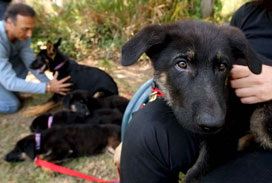 AFP: David McNew/Getty Images |
A search and rescue dog who helped to locate people trapped in the rubble of 9/11 attacks cloned in the USA.
Trakr, a German shepherd search and rescue dog which belongs to a former Canadian police officer, James Symington, died last April. Trakr cloned by BioArts International dog cloning company. Mr Symington took the possession of five off springs of his very talented beloved search and rescue dog.
He was quoted by Reuters news agency as saying that he would like to see cloning used for socially useful animals such as rescue dogs. This statement brings up the question if search and rescue dogs can be an exception in pet cloning. However, scholars in the UK do not agree with this.
Dr Richard Twine of Lancaster University’s Centre for Economic and Social Aspects of Genomics evaluates the emotional framing of cloning search and rescue dogs, and he continues:
“In advocating cloning are we making the assumption that all of a dog's qualities are biologically determined? Are we assuming that just because the dog is more or less genetically identical that the dog will behave exactly as the first dog?”
Josephine Quintavalle, founder of Comment on Reproductive Ethics finds process of cloning wasteful and unhealthy for the off springs. She says:
“…they can easily train another dog as a search and rescue dog. It is not difficult to breed dogs with normal prices if you want why they need to clon them?”
Cloned dogs cost an average 144,000 dollars each.
Sources: UPI, AFP, Reuters
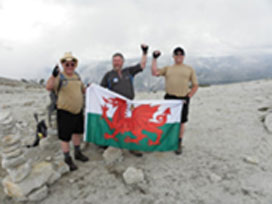 Three 60's challenge completed
Three Mountain Rescue team members from North Wales who travelled to Yosemite National Park in America to raise funds returned home this week.
The group intended to tackle Half Dome, a 17 mile hike classed as very strenuous, involving 4800 feet of ascent and descent.
Dave Fildes from North East Wales Search and Rescue (NEWSAR) and Roland Layland from Llanberis Search and Rescue Dog Association (SARDA) are two dog handlers, and the third participant Harold Burrows is the chairman of SARDA Wales.
The walk, called “360 to Yosemite” which was the first fundraising event the group organized, started at 5.45 in the morning on Saturday June 13 and took 11 hours to complete.
Dave Fildes, of NEWSAR, said: “We raised an excess of a thousand pounds. We funded the trip ourselves. So there is no money coming out the sponsorship,
“It was my idea. The idea was to celebrate our 60th birthdays. We are all 60 and between the three of us we have 120 years of mountain rescue experience, hence ‘360’.”
Harold Burrows, of SARDA Wales said: “It took us 11 hours to get to the top of Half Dome and back again. While we were on the top people were taking photographs and we were very pleased with ourselves. The weather took a turn for the worst, it hailed. So we decided to descend the Dome by cable. “
The group plan to organize more challenging fundraising events in the future.
Microchip dogs for life
 The National Microchip Month campaign is running throughout June in the UK to get all pets identified permanently through the painless process of inserting a microchip.
A tiny chip is inserted underneath the skin of the neck using a quick and easy injection. The microchip has a unique fifteen digit number which provides permanent identification for the pet.
Simon Clark, of Avid Plc microchip company’s marketing department says: “There are three databases in the UK on which to register pets. We all work together. But actually the chip itself only contains the chip number. The information related to the pet and owner, is all stored on a database.”
Robin Furniss, a dog handler from UK Fire & Rescue Service Urban Search and Rescue Dog team says that their dogs are all microchipped. He continues: “It is basically done for two reasons. One is obviously to find dogs lost in the UK. The other reason is that we take our dogs overseas. When the dogs come back into the UK they have to be microchipped anyway, it is part of the process.”
The National Microchip Month campaign is offering a discount to encourage pet owners to register their pets with the database.
09/06/2009
Search and rescue group seeks new volunteers
Wiltshire Search and Rescue (WILSAR) group is having a meeting tomorrow, June 10, at 7.30pm in Devizes to meet new members.
WILSAR helps in the search for people missing in the county. The group works in conjunction with the police and search-and-rescue dog teams to find missing people such as those with dementia or young children.
WILSAR’s membership officer Sean Caine said: “It will be introducing new members to the team. So the people thinking about joining will come along and be given an introduction about the team,
“WILSAR is a voluntary organisation as many search and rescue teams in the UK. We are always seeking for donations from people. We also do some fundraising events. We are a very busy team. So we had 23 callouts this year.”
The team is consisted of volunteers from different range of backgrounds and is a quite rewarding experience.
Mr Caine said that they would also welcome people who did not want to be involved in but who can offer other skills such as fundraising or PR.
The evening is informal and will give anyone over the age of 18 the opportunity to meet the team.