

 READ:
Strict quarantine rules for rescue dogs to be relaxed?

READ:
Could British rescue teams have saved more lives?

READ:
Funding dilemma of search and rescue dog teams

PROFILE:
Mesut & Maya from Turkey
Could British rescue teams have saved more lives?
The figures show that British rescue teams saved less lives compared to the other teams in Iran, Algeria, Turkey and Pakistan earthquakes. Kubra Yelkenci investigated the issue.
Nick Cater from the Guardian initially brought up the subject in his article after Iran earthquake:
“The British search and rescue teams arriving back from Iran have successfully proved that flying in people and dogs to scour the rubble and mud of foreign disaster zones for survivors with hi-tech gear or their bare hands is in almost all cases a waste of time, effort and money.”
Mr Cater says 68 search and rescue experts from five different UK groups with four dogs failed to find a person in Bam. He continues: “The story was much the same in other recent disasters, such as the earthquakes in Algeria, Turkey and India, after which few people have been found alive by British teams.”
Source: |
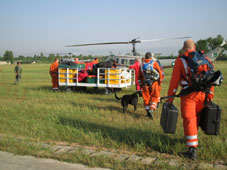
In Pakistan earthquake UK Search and Rescue teams - 84 experts with 4 dogs – who rescued 13 of the total 24 survivors saved from the rubble whereas the Turkish teams saved nine and the Chinese saved three.
Paul Baker, of Hampshire Fire and Rescue Service Urban Search and Rescue (USAR) who has been abroad several times says that their teams’ failure was resulted from plenty of reasons:
“...the local teams are picking people who can be easily rescued or picking up piece of woods or looking underneath it. What we do with other people who were actually buried within the building. We are a specialist heavy rescue team we would first locate where the person is then we would tunnel deep into the building,
“We take special equipment, cutting gear, cameras that everything to do with really technical stuff. That’s why we don’t rescue a lot of people we rescue the people that other teams cannot rescue.”
Nick Cater says that local teams have the advantage of “golden hours” which are the first 24 hours right after the disaster to find people alive, and he continues: “... it is local people who recover the vast majority of survivors, often based on knowing exactly where their families and friends were when the disaster struck.”
However, Mr Baker says: “These are actually the people who would die if we weren’t there they cannot be detected because they are too far down so that’s how we only we deal because our rescues are seven - eight hours long just walking across a rubble tunnel picking people up we can pick up four five people in initial stages in 10 minutes. So that’s why you have difference in the numbers.”
Mr Baker says that the cultural and religious aspects have also an effect on search and rescue process:
http://www.guardian.co.uk/society/2003/dec/31/internationalaidanddevelopment.comment
http://www.humanitarianinfo.org/hic-pakistan/documents/PAK-EQ-Sitrep-No5-10oct.pdf

NEWS: A rescue dog cloned
A rescue dog which worked in 9/11 cloned in the USA bringing up the debate of pet cloning in the UK. MORE

NEWS:
Three 60's challenge completed
Three Mountain Rescue team members from North Wales who travelled to Yosemite National Park in America to raise funds returned home this week... MORE

NEWS:
Microchip dogs for life
The National Microchip Month campaign is running throughout June in the UK to get all pets identified permanently through the painless process of inserting a microchip... MORE
NEWS:
Search and rescue team seeks new volunteers
Wiltshire Search and Rescue (WILSAR) group is having a meeting tomorrow, June 10, at 7.30pm in Devizes to meet new members. MORE