






The Importance of Family in Recovery
 |
|
|
|
|
Does family play an important role in recovery, or are they the 'forgotten voices'?
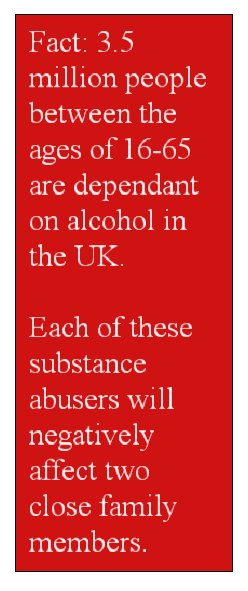
Alcoholism is known as a family disease. Research shows that at least two members of the alcoholic's family are affected by their addiction. 
Initially, alcoholics have a normal family pattern just like everyone else. They have children, spouses, parents, siblings and other relatives.
Family councillor, Paul Spanjar, at Providence Project rehabilitation centre in Bournemouth said: “An alcoholic can totally destroy the normal functioning of family life and cause negative physical, emotional and even social effects to other family members, and these can last a lifetime.”
This is a fact which is often ignored by the family and the addict. He goes on to say that the family gets so involved with helping the addict that they forget to help themselves.
Each member of the family is affected by alcoholism in their own way. Usually the children of alcoholics are affected the most. Many of them have their own symptoms of the disease. These include low self-esteem, loneliness, guilt, helplessness and even chronic depression.
John*, 29, spent most of his childhood trying to understand his mothers alcoholic behaviour. He goes on to say: “I kept my family life secret and hardly had any friends. I didn’t want anyone to know what my life was really like. I hated going to school and felt like I was good for nothing. Life was miserable until I joined my mother in her addiction. Once I started drinking I thought my problems would be over, but what I didn’t realise was that they were only at their start.”
Figures suggest that there are nearly four million people in the UK who have grown up in a family where one or both parents drank to excess (NACOA,
 2001-2002).
Moreover, adult children of alcoholics often find themselves in a pattern of problems relating to their alcoholic parent. One of these patterns is difficulty in establishing healthy relationships with others. Sometimes they even develop relationships or find themselves intimately involved with someone who is an alcoholic, or in some way abusive.
Alcoholism may have negative effects on the spouse of the alcoholic. Mainly because the spouse often has to play the role of both parents and family responsibilities are shifted to just one person. Moreover, the family would start to live a lower lifestyle as most of the money would go into buying alcohol and bare necessities would be ignored.
Studies based on alcoholic families show that family and marital problems are inevitable. However, they also show that families may add to the drinker’s habit. Some of the families do not know how to control heavy drinking and deal with the problems. They allow the drinking to continue in order to keep the family together.
According to Paul Spanjar: “Denial isn’t just a problem for the addict. It is also a problem of the family. Most families do not understand what addiction is. Moreover, they try to protect the addict's reputation by covering up their habit. This enables the addict's dependency on alcohol, and the family may not realise it but in this way they are making the problem worse. The sooner the family accepts it, the sooner the addict will ask for help.
The families too need a certain amount of recovery. People don't think that families play an important role but they are actually your biggest support."
There are many treatment programs to help people with alcohol dependence to stop drinking and make a change in their lifestyles. However, there are also self-help groups for families of alcoholics to get the understanding and support they need. They enable the families to interact with others experiencing the same struggles.
There are also rehabilitation centres that provide special group therapy and family sessions. Recovering addict Jitesh Sanghania says family support is essential. He goes on to say: “Family involvement in the recovery process gives you the feeling that you are not alone in your recovery. It makes you feel that your family is willing to stand by you through this and they are willing to understand your disease.”
However, John *, who has now been sober for over three years says that not everyone is fortunate enough to have a supportive family. He goes on to say: “Family therapy groups are helpful to some. But some alcoholics, like me, don't have families that are willing to understand the addiction. Despite various visits to Al-anon meetings, my wife did not understand my alcoholism and eventually left me. The sad thing is, if I had cancer she would have supported me, it is because I was an alcoholic, she chose to leave.”
It must be accepted that alcoholism as a disease affects each member of the family. Paul Spanjar adds: “The family has to be willing to accept the past and move on. They may not be aware of the emotional trauma they have been through while dealing with the alcoholic family member. This will enable them to be supportive and help the recovery process for the addict.”
However, John* goes on to say: “family support is important but not essential. The most important thing is to want help yourself. If the willingness to sober up is there, you can do it without family support. Because I was living with my mother who was also an alcoholic I had no support when I needed to clean up. I did it myself. At the end of the day, it was my own choice and I was my biggest support.”
Click below to listen to what John* and Jitesh have to say.
*John's identity has been obscured for reasons of anonymity. An actor has been used to voice his part.