
Eve Jackson talks about her current college and her daughter's position.
Eve talks about the physical effect the experience has had on Tiffany.
And on how her personality has changed recently as well
Finally, Eve offers her opinion on the extent of the improvement in services offered children with learning disabilities.
- Intro
- History
- The Battle
- The Effects
- The Future
- The Council's View
A Tale from the Cliff Edge
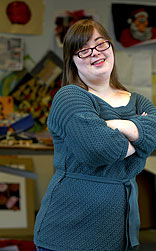
Tiffany Jackson
Tiffany Jackson moved to a specialist residential college when she was 16. She is 19, has Downs Syndrome and in the last three years has lived at a college learning all the requisite skills to eventually learn how to live independently. Eve, her mother, has spent the last year trying to organise her daughter’s future and has found it very difficult to ensure Tiffany gets her preferred choice for her transition. They have made it clear what their choice is, however it has been a struggle to get her into the residential college she wants to go to. Eve explains the story and outlines at a ground level how transition is dealt with in one part of the country. Some local authorities are better than others, but the Jackson’s experience would suggest that the system isn’t quite perfect.
Please click on the top clip to find out about her current position.
“There’s no next step, the next step should be what we’re looking for but nobody’s helping you get to the next step, there’s nothing set in place”
“I arranged a meeting last year when Tiffany started her final year to start the process of transition. There was supposed to be a transition worker, a social worker and me but the social worker didn’t turn up and since then it’s been an uphill battle. I’ve had to find places to look at myself and battle with social services to get funding for Tiffany’s future. I finally arranged a meeting with social services who told me that she didn’t need a social worker. I told her that she does because she’s going into transition. We finally got a new social worker and agreed that independent living was the best option.
“She would be very vulnerable if she was living on her own yet they’ve tried to convince us that she can live on her own, use individual budgets and go anywhere she likes. She doesn’t want to come home but she isn’t ready to live independently yet. We haven’t worked for three years to get her to live independently for her to move home but her future still hasn’t been decided and we’re only a few weeks away from the end of her time at her current school.
“I’ve found somewhere for her to go, it’s classed as residential but they’re very much out on their own. It’s the right step for her between school and being fully independent. Initially, social services refused to fund her and recommended fully residential care which I rejected because I thought she would get lost in the system. They’ve since agreed verbally to fund her but unfortunately there still isn’t a place yet at this place.
“They’ve said there will be a vacancy coming up but we don’t know when. If nothing comes up and she comes home, she’ll be off the list and she’ll be forgotten about.
“She could struggle if she shared a place with people. It’s the vulnerability with a lot of these students that they could be taken advantage of if she shared a house. The vulnerability of her living alone in a place is terrifying. She’ll wander off in that situation whereas now there are people about to stop her.
“She wouldn’t be able to do what she wants because she needs a carer to take her out. The place I’m looking at they can do all that and eventually they do lead them onto independent living and she wouldn’t have so many changes in her life. They have satellite units where she could eventually move out and maybe become independent.
“They knew she was funded for three years and in the last year you start looking for something, this has been going on since September so it’s been ten months and we still haven’t gotten anywhere. They kept on saying you’ve got plenty of time but that was four months ago and we only have four weeks. What do they expect these people to do, sit at home and do nothing, or go and do a silly day job in a factory type place for learning disabilities – that’s no life, that’s no life at all. She’s used to going out and going to the pub and learning to look after herself.
Please click on the middle two links to listen to Tiffany's mum talk about the effect the experience has had on her.
Eve told me about her immediate concerns and her hopes for Tiffany's future:
“If she comes back at the end of July and she doesn’t have a place or nowhere guaranteed in a month's time she’ll be forgotten about. By that time, I’ll have nothing to blackmail them with, at the moment I can say “She won’t come home” but I’ve known parents who’ve turned round said “They’re not coming home, they’re homeless and have housed them elsewhere. That is the hardest thing for any parent to have to do, to say sorry, you’re not coming home. I don’t know if I can do that when the time comes, it’ll be so difficult. If I don’t stand my ground she’ll come home and it’ll be even harder to get something because it’s not costing them anything is it.
“In five or ten years time, hopefully she will be sharing a house with other people and going out to work, maybe she will be married to the young man she’s unofficially gotten engaged to. They’re very loving people and she’s very much in love and devoted to this young man at the moment. But they’ll be split up this year so that’s more heartbreak for her. I’m hoping that she will be self-sufficient in many ways so that as I get older she can live independently.”
Please click on the bottom clip to listen to Eve's mum's opinion on things in general.
Northamptonshire County Council said in a statement:
""As a council we are committed to ensuring young people with disabilities receive the support they need and transition planning is begun during year 9 to help them plan for their future and to achieve their goals in adult life. We have a policy and procedure for young people transferring to adult services from children services, including a joint planning meeting which involves a care manager, social worker, the child and family and we have no reason to believe this procedure wasn't followed in this case.
"Our pilot scheme which gave people the chance to take up individual budgets whilst still receiving full support from social care staff won a regional health award earlier this year and is now being extended to make self-directed support and individual budgets the main way of working with all people with a learning disability in Northamptonshire include more customers."
They also sent me forms which confirm that some meetings took place in the last year.
Paul Cunnisse, Transition Officer, Hinwick Hall
"We're still in the process of putting into a place a really good transition process here and I'm hoping to build on this in the coming years.
"In the first year at school the kids try and settle in, then in the second year we think about where the money should be spent and in the third year we start to think about where they should go.
"There is a range of information given and connexions are heavily involved in ensuring that this is given."