Skimpy clothes not linked to rape – but Indians still disapprove of mini
 Almost 40 percent of the South African town Bloemfontein residents believe that if a woman is revealing clothes, she is asking to get raped.
Two years ago the researchers concluded in a similar study that Indian men were most likely of all South African race groups to agree that women who dressed in revealing clothes “were asking to be raped”.
The latest research however showed the biggest change in the attitude among Indian men, from 55 percent in 2006 who agreed that revealing clothes contributed to rape to only 20 percent in 2008.
“Interestingly, the 2008 study showed that white men, at 11 percent showed the lowest level of agreement, while black men, at 29 percent had the highest,” says Neil Higgs, director of TNS Research Surveys.
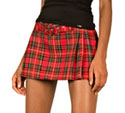
But when asked how they felt about miniskirts, 33 percent of Indian men and 36 percent of black men agreed that women should not be allowed to wear the piece of clothing.
"It's not really the mindset that has changed," says Nisha Vijayan, 23, of Bournemouth. "It's more that men want to be more politically correct these days. In just two years women have come so far ahead, that men have to be careful what they say."
Government battles teen pregnancies
 Teenage pregnancies are a major concern for health professionals across the country, according to health profile figures released this week.
Regionally the numbers vary. In Dorset, for example, 49 in every 1,000 girls under the age of 18 become pregnant (the national average is 41).
The government wants to cut the teenage pregnancy rate in two by 2010 and has introduced a number of strategies to make it happen.
Teens are getting more time with health education and social services, and sex education within schools now has a higher priority.
Anne Galton of the Teenage Pregnancy Strategy Group in Poole approves of the strategies. “It is crucial to keep channels of communication open,” she says.
“Teens should be able to talk openly with their parents, because they then often delay their first sexual experience.”
"And learning about sex and relationships doesn't make people have sex. It just gives them the information so that they are able to make choices when they are ready."
Now social networking sites such as Facebook and Bebo are being used to improve sexual health of teens.
Banners on websites will link to other websites offering free postal chlamydia testing kits and advice on contraception, pregnancy and STIs.
Back to top
99 percent of women shave
 A research has shown that 99 percent of women shave occasionally. Most popular are smooth armpits (92 percent), the bikini line (82 percent) and legs (79 percent).
The Dutch research was done for Playboy and Philips and published last week.
Almost all men (92 percent) appreciate if a woman shaves because it looks more hygienic (70 percent), prettier (60 percent) and sexier (53 percent).
Not everybody agreed, however.
“Women are taught that 'beautiful' means fitting within a certain body shape and type,” says radical feminist Anji Cape from Southsea in response to the research.
“It is a systematic requirement placed on women to have completely hairless bodies just to fit in. Something completely natural is transformed into something 'unnatural'.”
But beauty specialist Dana de Vries from Amsterdam promotes shaving. “Depilating has certain pluses: a woman is more sensitive, it looks prettier and it is cleaner.”
“And there is no real clinical need for pubic hair in this day and age - clothing certainly provides ample protection and warmth.”
According to Mrs De Vries the Brazilian is most popular is her salon. “It gives the freedom to wear even the most revealing swimwear and lingerie.”
Miss Cape commented that not everything 'unnatural' should be eschewed. “I believe many unnatural things - brick houses, electric trains, gas cookers - to be very useful.”
“But the problem is that something very natural like body hair is rewritten so that people believe it is unnatural. And this unnatural action has no benefit whatsoever.”
The research was conducted in April amongst 500 Dutch (50 percent women) ranging in age from twenty to forty.
Back to top
Miniskirt empowers more than it shocks
 Wearing a miniskirt is not about seduction or provoking, argues Sarah Charles, leader of the Fashion course at the Arts Institute in Bournemouth.
“The miniskirt is a sign of empowerment, not of sexualisation.”
Instead, the mini still relates today to the Spice Girls' 'girl power' from the nineties, says Mrs Charles. “In a sense the miniskirt is a form of ambition, assertiveness and individualism.”
“In the sixties a mini was a political statement, it related to sexual liberation and the introduction of the pill.”
While a miniskirt may sometimes be perceived as “trashy” today, it's not shocking any more, says Mrs Charles.
“Really, I don't think anybody is impressed by a mini nowadays,” says Liselotte Heikens, 21.
“If you want to shock, you'd take a piercing.”
A miniskirt may be tasteless at times, according to Liselotte, but it can never serve as an argument to call a girl a 'tramp'.
“You know, in a way the miniskirt is a form of civilisation. We can wear whatever we want, and the clothes will have no consequences for the way we are treated. And we still have the same rights.”
“Plus, I really enjoy when men are looking at my legs. They're just pretty.”
Back to top
news ARCHIVE
Skimpy clothes not linked to rape – but Indians still disapprove of mini
4 july 2008
Government battles teen pregnancies
27 june 2008
99 percent of women shave
20 june 2008
miniskirt empowers rather than it shocks
13 June 2008