
RENEWABLE ENERGY
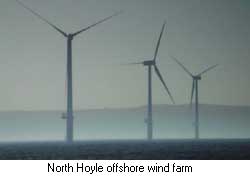
The government should invest more money in renewable technologies and look to decentralising energy claim political figures.
Renewable forms of energy such as wind, solar, tidal and hydro currently provide just 4% of the UK’s energy demand, but there are calls to increase this percentage to help reduce carbon emissions from energy generation.
With the energy review due for completion in early July, campaigners have criticised the government for lack of investment in renewable technologies.
In the 2003 energy white paper the government announced that renewable energy will meet our needs and must receive further development, but some claim they have failed to deliver on their promises.
Mike Birkin of Friends of the Earth said: “Government have failed to put their money where their mouth is when it comes to renewables, failing to give the solid support and impetus it needs.
“It’s a fledgling industry trying to get going in this country and government support just isn’t there, its wayward, haphazard, hopelessly ineffective support.”
Ministers are also calling for more investments in renewable technologies and decentralised energy to reduce the two thirds currently wasted through heat and transmission.
A decentralised model of energy production will see the UK move away from transmitting electricity along pylons from power plants located on coasts and rivers, in favour of solar panels, wind turbines and combined heat and power boilers.
The energy generated can feed directly into the home or business and any excess can be fed back into a local grid network.
Tom Tibbits of the Green Party said: “The government is grappling with ways and policies that will develop this localised, decentralised model in favour of the current centralised model we use. But I would strongly assert that a young masons industry like the renewables industry deserves government subsidies to help it survive and give it a chance.”
But not everyone is supportive of renewable technologies and therefore investment may not be the only barrier to overcome. According to Greenpeace campaigners many wind farm proposals throughout the UK have been rejected on the grounds of aesthetics with the prominent argument they blight the landscape.
However when we look at tackling climate change it’s a case of weighing up the balance as Tom Tibbits would argue:
“One has to take the pragmatic view that whilst the aesthetics of wind farms is a subjective opinion, we must look ahead to the overall security and sustainability of the UK and put these subjective concerns to one side.”
“If we are serious about reducing carbon emissions then renewables technologies have a key role to play”, he added.
Liberal Democrat shadow environment secretary Chris Huhne said: “There are number of big solutions in the field of renewables. Let’s subsidise new technologies with a future that are clean and green and don’t have potential threats to the environment.”
One project being mooted at the moment is for an enormous wind farm in the middle of the North Sea, which would feed electricity into the national grid for the UK, the Netherlands and Germany.
There are also schemes that are looking at using the high tidal shift in the Severn estuary in order to generate electricity. It’s estimated that this could produce five to seven per cent of UK electricity needs.