GURKHAS AVOID IMMIGRATION CAP
30 June 2010
Gurkha soldiers and students from non-EU countries will not be affected by proposed changes in British immigration policy.
This has saved the Gurkhas from grappling with the new coalition government on immigration matters.
Changes to immigration of Gurkha soldiers were highlight of the Labour government when it suffered embarrassing defeat at the Commons.
Home secretary Theresa May announced yesterday that the government intends to scale back net migration to the levels of 1990s.
This means , the numbers will be tens of thousands rather than hundreds of thousand.
The details of the new capping system will be delivered following a consultation with businesses however, an interim limit will come into force from 19 July 2010 to avoid rush in applications.
Ms May said: “Britain can benefit from migration but not uncontrolled migration. I recognise the importance of attracting the brightest and the best to ensure strong economic growth, but unlimited migration places unacceptable pressure on public services.
The government will also introduce measures to support British people. Alongside limits will be action to get Britain back to work and provide business with the skills they need from the resident workforce – reducing the need for migrants at the same time as we reduce their number.”
BRITISH FUNDS HELP NEW RECRUITS
23 June 2010
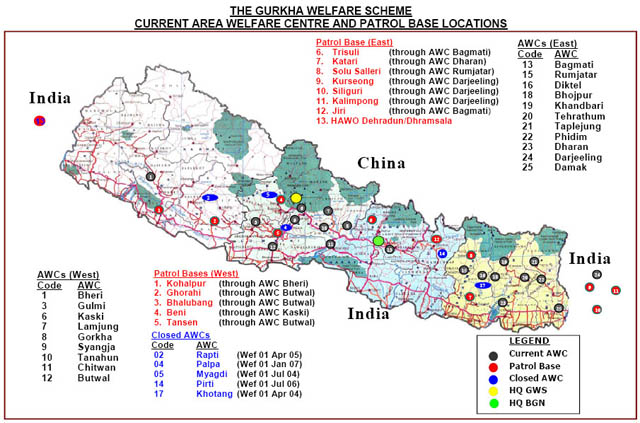
Image courtesy: Gurkha welfare Scheme
Money raised from the British public will be used to fund development schemes to help potential Gurkha recruits.
Funds in lieu of £40 thousand are provided by the British Gurkha Welfare Scheme for the British Gurkha Aid Projects.
The projects are planned mainly in the areas from where the British Army takes its recruits. They include drinking water projects, construction of bridges, schools, micro-hydro plants, solar power schemes and cliff tracks.
A meeting held in Kathmandu, capital of Nepal, yesterday between defence secretary Navin Kumar Ghimire and the representatives of the British Gurkha Welfare Coordination Committee approved the projects.
The work for the projects is planned for the financial Year 2010/11.
The Director of the British Gurkha Welfare Scheme, Colonel Andrew Mills, discussed the individual and community aid projects that the Scheme during the meeting.
The scheme had provided £30 thousand for various community aid projects last year.
The GWS is the field arm of the Gurkha Welfare Trust (GWT), a UK based charity. The GWS is based at Pokhara and is run on a day-to-day basis by the Field Director GWS and his staff.
They investigate all claims for aid from ex-servicemen and frequently the circumstances of serving soldiers' families. Aid dispersed by the GWS is directed to support ex-servicemen and their widows either individually with welfare pensions, hardships grants, medical grants and education grants or communally through projects such as water points, schools and suspension bridges.
GURKHAS TO BENEFIT FROM OXFAM TRAILWALKER
16 June 2010
A team of army wives calling themselves ‘Gurkha Girls’ are attempting to raise money for the Gurkha welfare trust this year. All four are wives of soldiers currently serving in Afghanistan. They are however, just one of the teams taking part in the Trailwalker 2010 organized by the charity organization, Oxfam.
This is a 100km run/walk across the arduous terrain of the South Downs to be completed within 30 hours on July 17 and 18. The money they raise will be split equally between the Gurkha Welfare Trust and Oxfam.
Member of the team Cathy Strickland said: “Training has started and we completed 40km last weekend. We appreciated the need to train hard but feel there is no room for moaning. Our husbands’ tasks in Afghanistan include at least that distance daily while carrying all their heavy kit and body armour in serious heat.”
The “Gurkha Girls” are hoping to beat last year’s fastest women’s team time of 21 hours and 27 minutes. The money raised by the event will go towards The Gurkha Welfare Trust.
It works to provide necessities such as water and sanitation facilities, schools, medical assistance and financial help to Gurkha communities.
The Trust also gives educational grants and provides vocational training to the children of the Gurkha regiment. A welfare pension and medical treatment is also provided to around 10,000 Gurkha ex-servicemen and widows living in Nepal who face destitution.
Trailwalker was started by Gurkha soldiers in Hong Kong in 1981 as a training exercise to test endurance and encourage teamwork. The Gurkhas currently hold the record for completing the course in 9 hours and 50 minutes. Trailwalker UK starts at the Queen Elizabeth Country Park, Petersfield, Hampshire on Saturday, 17 July.
The first group will set off at 6am. Further groups will set of at 7am, 8.30am and the final group at 10am.Trailwalker is a worldwide event and is regularly held in Australia, Hong Kong, Japan, New Zealand, Belgium, Netherlands, Canada and Ireland.
MEDALS TO THE LOGISTIC REGIMENT
9 June 2010
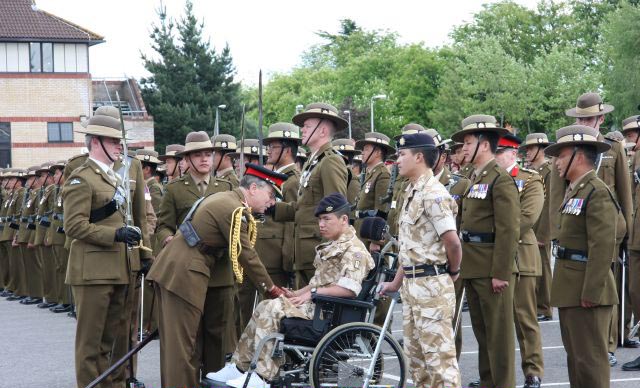
Private Kiran Gurung receives campaign medal from CGS General Sir David Richards
A wounded Gurkha soldier was applauded for his bravery and awarded a campaign medal at the medal ceremony in New Normandy Barracks in Aldershot.Private Kiran Gurung was wounded by a land mine during a logistics deployment to Afghanistan.
The medal ceremony for the Queen’s Own Gurkha logistic Regiment was attended by various armed forces dignitaries and families of the soldiers.
The regiment deployed to Afghanistan in 4 components for 6 months. This included the transport squadrons QOGLR, Close Support Logistic Regiment, Fuel Squadron RLC and the Petroleum Troop.
The 250 officers and soldiers deployed to Kabul and Helmand of Afghanistan returned in March.
They were responsible for supplying the troops in Afghanistan with fuel, food, water and ammunition.
A Long Service and Good Conduct medal was also awarded to Gurkha Sergeant Purnabahadur Thapa on the occasion.
The Chief of the General Staff (CGS), General Sir David Richards said: “The Gurkha logisticians delivered the campaign in Afghanistan is rugged, durable, Gurkha soldiering with an affinity for the Afghan people and their culture. The Gurkhas added value edge.”
The Queen's Own Gurkha Logistic Regiment, formerly The Queen's Own Gurkha Transport Regiment, The Gurkha Transport Regiment and The Gurkha Army Service Corps, was formed as a component part of The Brigade of Gurkhas on 1 July 1958.
Her Majesty the Queen approved the redesignation of The Gurkha Transport Regiment as The Queen's Own Gurkha Transport Regiment in 1992.
The Regiment officially became The Queen's Own Gurkha Logistic Regiment on 5 April 2001.