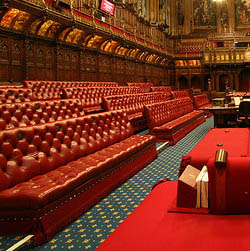
 The Contaminated Blood Bill was reintroduced into the House of Lords by Lord Morris (image courtesy of http://parliament.uk)
Government backs down on judicial review
Lords are continuing to pressure the British government to act on the Archer Report.
This comes after the government announced it was not going to appeal a Judicial Review concluded in April, brought to court by contaminated blood victim Andrew March.
March, 36, challenged the government's decision not to raise compensation levels of those of Ireland, which was a recommendation of the contaminated blood inquiry, the Archer Report.
The Parliamentary Under-Secretary of State for the Department of Health, Earl Howe told a full House of Lords:
"We have decided not to seek leave to appeal the judgment, and we will be writing shortly to let the court know."
The British government has maintained their justification since a court hearing in 1991, that led to the establishment of an ex-gratia payment scheme known as the Skipton Fund, a one-off £20,000 to £45,000 sum the government pays to contaminated blood sufferers.
They have since claimed that they are not liable for full compensation yet campaigners say the Skipton Fund is too little.
Lord Alerdice was one of many peers to question Earl Howe on the implications of this decision:
"Does the noble Earl agree that the High Court judgment shows a confusion of thinking on the part of the Department of Health not only in regard to this matter but on the whole question of dealing with adverse health events?"
Lord Archer questioned the government's stance, asking Earl Howe whether "it is now accepted," that successive British governments should have appointed a public inquiry instead of only the privately-funded one that he chaired.
Earl Howe's responded:
"I cannot speak on statements made by Ministers of the former Administration."
Campaigners continue to appeal to get the private member's bill, the Contaminated Blood Bill, parliamentary time.


WEEKLY NEWS
Cameron backs Skipton Fund review
7.7.10
Contaminated blood film to denounce Factor VIII
30.6.10
Protest comes as FDA imposes blood fine
23.6.10
Government backs down on judicial review
16.6.10