








Let’s talk ‘race’: Profiling the powers that are!
A British Indian businessman who has taken on the leadership of the Dorset Race Equality Council temporarily believes his appointment to this position more to do with his mixed ethnic background than with his business skills.
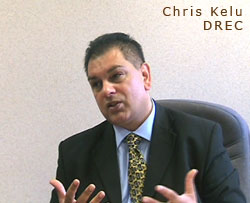 Christopher Kelu, the acting chief officer of the DREC on secondment from Bournemouth Borough Council, is a British Indian with a difference. Claiming that he hates tags like ‘British Indian’, he says: “I personally don’t like titles, but I think for a lot of people they are very important. British Asian doesn’t actually mean an awful lot to me apart from that it is a statistic for the government.”
Chris’s father came from Madras in India as a migrant to the UK was of Anglo-Indian antecedence. However, his mum is English and he was born in Yorkshire.
As a child, Chris went to a Roman Catholic school and since he didn’t have an Indian accent, had few or no racist incidents that he can recall. “I have to be honest,” he says, “I think it is probably more difficult for young people these days growing up. I think a lot of people would probably say were you bullied in school, were you called names, and to be honest because I was born here and I didn’t have an Asian accent , an Indian accent, I think my peers and my teachers accepted me. So I can honestly say that I didn’t receive any racism in school. But I do think that’s probably changed now.”
So how difficult was it for Chris growing up in a mixed ethnic background? He says ‘not at all’.
“I consider myself more English than Indian, I think the reason being personally I grew with here in this country and I didn’t get an opportunity to learn much from my dad about the Indian way of life. However, I do feel more Indian when I am with my Indian side of the family and I do feel more English when I am with my English side of the family. There’s nothing to be confused in that. I am not confused about my identity.”
Annette Pettifer, office administrator at the DREC who has known Chris for a while now also says that he does come across as more of an English person than someone with a mixed background. “Whilst he always makes it a point to mention his Indian background, I think he does consider himself to be more English than anything else. In fact, when I look at him even I can’t consider him to be anything else other than an English person with a tan I guess.”
Chris considers this as an advantage to his position and says that it has only helped him understand the underlying causes of racism. He says: “Wherever you have racism or hate crime, I can tell you from my short experience of life that the reason behind it is peer pressure, but it is more to do with ignorance. It is ignorance of other people’s cultures. If you know about other people’s cultures, then you tend not to be ignorant and there tends not to be any racism. Whether it is the colour of somebody’s skin, whether it’s about a disability, whether it’s about sexual orientation it’s only because you don’t know people.”
While his term with the DREC ends in November, Chris reinstates that he intends to make as much a difference as possible.
Click here to watch a video clip of Chris explaining his role and views with regards to racial equality work.
---------------------------------------------------------------------------------------------------------------------------------------
OTHER BRITISH INDIANS FIGHTING RACISM BOLDLY:
Kuldeep Benepal is not only a board member of the Dorset Race Equality Council but also a magistrate and a businesswoman.
Having lived in the UK for 40 years now, she understands the issues that British Indians have trying to integrate two cultures that are so starkly and obviously different.
Kuldeep talks about what motivates her to do something for the racially discriminated in the audio clip below:
Inderpal Kaur Singh, assistant chief executive at the Black Development Agency is another British Indian making a difference.
Born and brought up here in the UK, she says growing up was not easy and she felt torn between two cultures at many instances. However, she decided to take a stand against racism and is now working closely with ethnic minorities on a daily basis.
In the audio clip below, Inderpal talks about the racism that she still faces in spite of working against it.