Simon Tilford, Head of the Business Unit at the Centre for European Reform, thinks businesses have yet to recognise the serious effects of their energy use which cause CO2 emissions. He stresses the need for businesses to take responsibility for their actions, “We need to move from this sort of paradigm where CO2 emissions are not seen as a problem where basically any company can emit carbon and it doesn’t pay any price for that.”
Businesses have found their own way of taking responsibility for emitting CO2. The CarbonNeutral Company assists businesses offset their CO2 emissions with a variety carbon offsetting projects. Carbon offsetting is a process that allows a company to balance their emissions by investing in or giving money to carbon offset projects to make up for their own emissions. One project in Donkleywood, Northumberland, England claims it will offset 20,000 tonnes of CO2 over 100 years if a company wishes to invest. The CarbonNeutral Company also helps with emissions reductions.
Earlier this year, Barclays announced it became carbon neutral with the help of the CarbonNeutral Company. In 2006, Barclay’s emissions within the UK amounted to 223,000 tonnes. In a press release “they stated 40 percent of those emissions [were] being offset through investments in small scale projects.” These projects included investments in renewable energy sources in India which included small wind power and rural solar lighting.
Some critics say carbon offsetting is not an effective way of tackling climate change and purely a way to validate emitting mass amount of CO2. Andrew Flett, Head of Environmental Management for Barclays, justified the company’s investments saying, “Going carbon neutral is a milestone in our environmental strategy but is absolutely not an end in itself. Focusing on energy consumption and sourcing an increasing part of it from green sources remain our top priorities. These make sense both from an environmental and financial point of view.”
Other businesses are beginning to make consumers directly aware of their CO2  emissions. Walkers Crisps began a pilot scheme early this year to put a carbon label on their products. This label makes consumers aware of the products carbon footprint from its production to disposal. A carbon footprint is a measurement of the amount of carbon dioxide emitted by a product, person, business, or country. With the help of the [Carbon Trust], businesses and carbon labelling have made it possible for companies to makes consumers aware of their consumption of goods and there relation to CO2 emissions.
Becoming environmentally friendly is a vital characteristic for most businesses to remain afloat in economies that are beginning to address climate change. The government has been able to work with businesses while instituting environmental policies when attempting to tackle climate change. The Institute of Directors cooperates with the government, acting as a liaison between business and government. As the government employs effective environmental policies, the IOD, ensures that its members in businesses needs are being met.
Geraint Day, Head of Health and Environment in the Policy Unit at the IOD, brings the views of organisations to the government while making sure the business sectors concerns play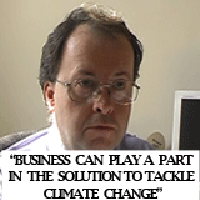 a role in policy discussions. Mr. Day says, “One of the things we want to see so that [government] wouldn’t disadvantage UK business is that the government wouldn’t take too much of a vanguardist approach with regards to climate change response. It’s actually the collective action of the EU, the UN and the whole world to actually tackle those issues but business can play a part in the solution to tackle climate change.”
He adds “one thing we’ve said to government is just don’t do things in isolation but do do them in a collective manner to achieve the best result for both sectors.”
As businesses make the transition towards becoming ‘green’, they will have to ensure they are putting their shareholders interests in climate change first while maintaining their economic benefits. Although satisfying both the public interest along with taking on environmentally friendly business models may seem like a difficult task business will continue to make evolve.