The Violent History
Gypsies have lived in Europe for over 500 years but they will only just be added in this year’s Census and counted as part of the population of England. They were recognized as an ethnic minority group about fifteen years ago and their numbers are estimated to be between 250,000 to 300,000 but is believed to be more than this and thus largely under represented.
They are said to have originated from the Indian subcontinent to Europe in the 1300s. Common belief is they came from Egypt and were thus called Egyptians which later on was shortened to Gypsies. At that time anyone who travelled required a document deeming them as Pilgrims. Gypsies thus came to be known as pilgrims. When King Henry VIII, who was ruling England at the time, separated from the Roman Catholic Church he ordered a ban on Gypsies when they sought entry into the continent on the basis of being Pilgrims in 1500. He believed them to be spies and passed an order stating the persecution of Gypsies and anyone who associated with them.
In the initial years of the Black Death (1300s), the Gypsies were relatively lesser affected as they stayed aloof. Farmers were badly hit as farm land workers had been majorly wiped out. Gypsies willing to do work stayed were hired and proved efficient as they came without housing and food hassles. In the later years the farmers would go on to protect them from authorities by lending their surname to them.
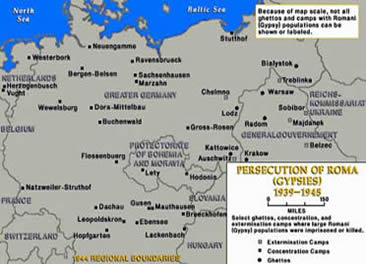
Map of Gypsy concentration camps
The other lesser known fact is that the gas used in the chambers in the concentration camps was initially tested on the Gypsies. The event of killing Gypsies was known as Porajmos (The Devouring). They were also extensively experimented upon and sterilized. One of the reasons Gypsies were feared stemmed from the apprehension of science and medicine in early years as they were used for tests.
Annmarie, who recently found out about her lineage, talks about Gypsy persecution by Nazis