Communities are ignored in the planning process: Fact or fiction?
Whenever you read the paper, or whenever you watch the news, there is usually a story somewhere about a proposed building development and the controversy it has caused.
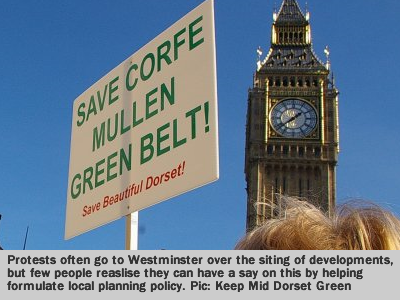
In most cases, these stories tend to focus on the views of protest groups – their arguments about the lack of public consultation and the absence of democracy in that final planning decision.
“We argued our case and won, only to be overruled by politicians in Westminster,” says Nigel Clark of the Stop Harlow North campaign group.
But do these stories of communities being completely ignored and steamrolled by politicians and developers really have any substance or is this just a well-publicised misconception?
In the Harlow case, there was the obligation by the council to meet central housing targets, and until recently the assessment of housing need in an area was not set by communities themselves. In this respect, accountable local decision making did not take place.
Things are getting better
But with most other planning matters, there is no doubt that public involvement and consultation has definitely increased.
Once upon a time, the perception that people were ignored was probably true says Hampshire County Council planning policy manager Pete Errington.
“In the old days, it was just consultation.”
He adds that councils were often criticised for holding public meetings and then ignoring what everyone said and just going ahead and building what they were going to anyway.
“That was a valid criticism of the old system,” he says.
But over recent years, legislation has been brought in to try and remedy this problem.
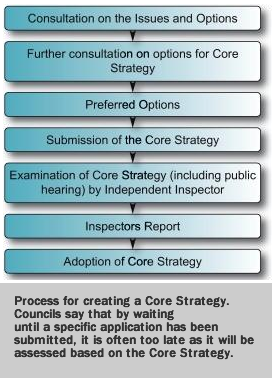
Full engagement with all stakeholders is now a legal requirement for individual applications as well as for ‘Local Development Frameworks’ and the ‘Core Strategies’, which are the local policies for longer term development in a county borough.
These statements explain to the public how they will get involved in the preparation of the local planning policies.
A system that is too complex for people to understand
Paul Jackson is head of planning and building at Test Valley Borough Council. He argues that while there is plenty of public consultation, the system is too complex for people to understand and may be the reason for the common stereotype.
However, she says that: “One of the major problems at the moment is that the system of plans is just terribly complex and as a result opaque.”
Pete Errington believes that “if the system needs to change, it’s not about encouraging more involvement but in educating people about how the system works and how they can best engage in it,” he adds.
People just don’t want to get involved until they have to, and then find the system frustrating
There is another problem too. Nearly all the councillors and council officers we spoke to said the same – people often don’t want to get involved until a scheme directly affects them and aren’t interested in helping shape local policy earlier on in the process.
Eastleigh Borough Council “sent out 30,000 leaflets to houses in the Hedge End area re the Strategic Development Area and got eight responses back,” Pete Errington remarks.
When the public does tend to step in, a frustration for many is that objections have to be based on planning considerations and you aren’t simply allowed to say ‘I don’t want this because it will devalue my property or ruin my view.’
Those objections will be ignored no matter how many people say it. For many, this will seem unfair.
Planners argue this is to try and be as fair as possible to all stakeholders concerned and to try and balance the wishes and needs of everyone involved.
Paul Jackson says how hard it is from his point of view to get people in favour of development – which is often a majority rather than the protesting vocal minority – to come forward and comment.
“What you tend to find in my opinion in that you’ve got a skewed view, you’ve got a minority of people that live immediately adjacent to a site who will lobby against a proposal when the community as a whole thinks it’s okay.”
Developers feel the same about this. They consider council waiting lists for homes and market demand to be in their favour and the reason why ‘no development full stop’ is rarely an option.
Mike Emett of Cala Homes says: “Planning tends to encourage a certain type of person to participate. It tends to be the educated people, the articulate people and often older people with more time to look into these sorts of things. That does cut out an enormous chunk of society.”
He believes that people need to be reminded of the bigger picture – the numbers of people that are difficult to personally identify who cannot get on the housing ladder because of the chronic shortage of affordable accommodation.
The system aims to take these people into account, and it has to consider the needs of people twenty years down the line today.
Weighing it all up
The system has improved in recent years and the new government says local communities will now have more control over housing targets for their district.
This is one area where community involvement has been at its weakest - 'No person has a right to be heard at an Examination in Public', the previous Act of Parliament says.
The problem is how to simplify the system to make it accessible and interesting. The challenge is how to make people realise there are families that will want houses in ten years time that have not yet formed but will need to be planned for already.
Shaking off the public image of unfairness is what both developers and politicians agree they have to do next.


 to said the same – people often don’t want to get involved until a scheme directly affects them and aren’t interested in helping shape local policy earlier on in the process.