The Science
Can the Welsh Assembly scientifically justify a cull of badgers?
"The Assembly Government is completely ignoring science and history by culling badgers.” - Badger Trust.
Badger Trust expert Mike Sharratt dismisses Elin Jones’ so called ‘scientific approach’ to TB eradication, in favour of one based on lessons from history.
Evidence from DEFRA supports Mr Sharratt’s brief history of bovine TB in the UK. It agrees that high levels of the disease in cattle of the 1940s were reduced to a very low level by the 1980s through slaughtering infected cattle and controlling movements from infected farms.
Why a cull?
So if TB has reduced so dramatically without culling badgers, why is a cull on the agenda for both England and Wales?
In a statement reaffirming her commitment to the cull, Elin Jones said: “I remain fully committed to fully implementing the wildlife control measures within the bovine TB eradication programme. Within the pilot area, 42% of cattle herds have tested positive for a TB breakdown within the last six years.”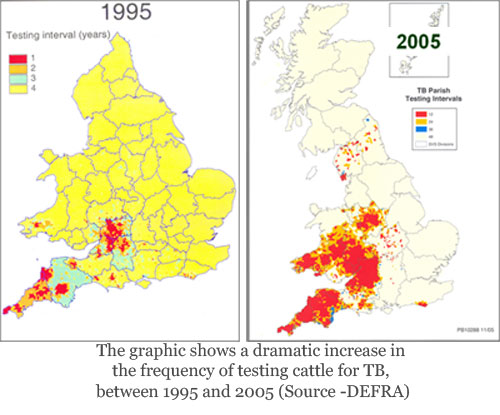
So according to official sources, the levels of TB infection have increased in the pilot area to proportions matching those of the 1940s, while the graphic (right) shows how far infected areas have worsened in recent history.
The WAG intends to eliminate at least 1,500 badgers in the pilot cull area over the next five years, which it thinks will reduce the incidence of TB in the area by 9%.
Legal challenge.
The Badger Trust has been fighting an ongoing legal battle over the cull. Their main avenue of contention is that the cull will not “eliminate or substantially reduce” the rate of TB infection in cattle and therefore it is not legal
Spokesman for the Trust, Jack Reedy said: “If there is any benefit from the action then it will be marginal, badger culling is certainly not a solution to TB.”
The Krebs Report
The most extensive scientific research into the effectiveness of culling was undertaken in 1997. The Krebs report, also known as the randomised badger culling trial (RBCT) concluded that culling could not help the situation.
In February 2007, the Independent Scientific Group analysed the after-effects of the RBCT and concluded:
Our findings show that the reductions in cattle TB incidence achieved by this repeated badger culling were not sustained in the long term after culling ended and did not offset the financial costs of culling. These results combined with evaluation of alternative culling methods, suggest that badger culling is unlikely to contribute effectively to the control of cattle TB in Britain.
But two months later a new report, the Jenkins paper was released, which concluded that culling could be successful in the long term.
On May 27th Wales’ Chief Veterinary Officer Dr Christianne Glossop released a video as reaction to the new evidence.
She said: “Evidence from a number of studies, including the Randomised Badger Culling Trials in England, shows that culling badgers can substantially reduce TB in cattle.”
Culling makes it worse?
It is the opinion of many anti-cull campaigners that a badger cull could actually exacerbate the problem of Bovine TB.
It is thought that if a cull goes ahead then badgers may flee the cull area and if they are infected, help spread the disease to farms outside the cull area.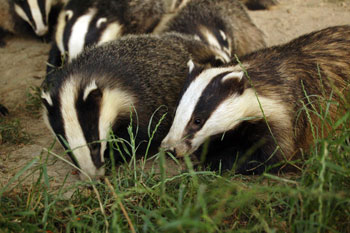
The Badger Trust’s Mike Sharratt said: “There is a circular system. Cattle give TB to the badgers and badgers give it to the cattle. If you start culling the badgers they will scatter and move the disease into currently uninfected areas.”
But NFU Deputy President, Stephen James believes there is a solution to this possibility: “If you cull within ‘hard’ boundaries then the badgers cannot escape as easily. Pembrokeshire has the sea on one side, the Preseli Hills on the other and the River Teifi and River Cych to stop the badgers.”
Cull opposition has pointed out the difficulty of culling every badger in the cull area.
Landowner with land inside the cull area, Mike Joseph said: “North Pembrokeshire is not and island and culling every badger is impossible. It’s ridiculous, badgers will just move in from outside the area.”
Vaccination
Badgers are a protected species under the Bern convention of 1979 and the 1992 Protection of Badgers Act , but the legislation allows for exceptions in both cases.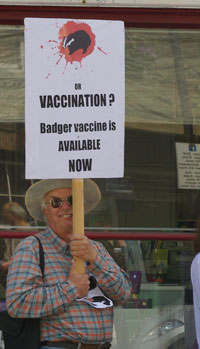
They can only be culled by authorities in order to, “prevent serious damage to crops, livestock, forests, fisheries, water and other forms of property’, as long as there is “no other satisfactory solution.”
Mike Sharratt said on behalf of the Badger Trust: “What we’re arguing is that there is another ‘satisfactory solution’ to the problem – badger vaccination.”
Anti-cull group Pembrokeshire Against the Cull (PAC) have been campaigning for the use of a badger vaccine instead of culling.
Dr. Gavin Wheeler from PAC said: “Vaccination is far less controversial than culling, less expensive, and more flexible, as it does not have to be used only in the summer.”
But cull supporters have raised questions over the vaccine’s effectiveness, in that it will not affect badgers which already have the disease.
The Welsh Royal Veterinary College’s Dr. Steven Van Winden talks about the advantages and disadvantages of the vaccine.
