

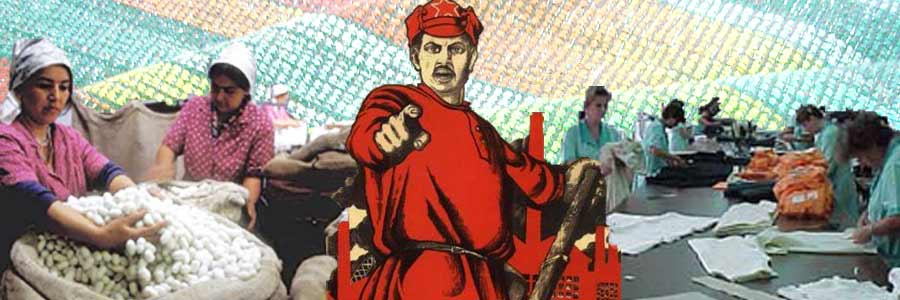
The Soviets would not approve
It is most likely that the kind of clothes we are wearing now, would not pass the quality test if examined bythe Soviet Union’s scrutiny board.

Jelena Kuznecova
“This sort of textiles, could not be possibly released from a factory line in the times of USSR. Now they are available in every store of a high-street. " said an ex chief-fashiondesigner from Latvia, Jelena Kuznecova.
Commonly portrayed as overwhelmingly controlling, socialism's regime was in fact very much benefitting society, providing strictest supervision and facilitating quality controls of industrial production. Hence soviets felt safer to buy USSR production and rely on the information provided on the labels.
“There was very clear categorization of textiles: a so-called technical and for the humans clothes,” explained Jelena. “Technical textiles used to be very specific and for particular purposes; and at no circumstances we were allowed to use them for a mass production.”
Extremely unpleasant on the skin, these materials could have been easily identified.
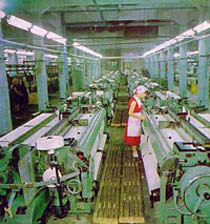
USSR textile manufactory
Numerous departments were involved in a textile manufacturing, guaranteing transparency from the very root of itsproduction. Invented in the mills’ laboratories, the textiles would go through ‘cosmonautic’ tests on ability to crease, durability, strength, fastness, endurance, and all possible body reactions. The swatches would also be approbated on the special drums, and “spun around like astronauts, “ says Jelena. Only then it would be brought to the Art committee's attention and for the Department of Efficiency and Quality's [DEQ] approval.
Yet the production of technical textile had to go through the same procedures involving a contact with human labour. According to Natalya Novikova, who worked at a chemical yarn manufacturer in one of the USSR provinces in 1979, said "This is not in vain, that workers from the department of hazardous yarns were retiring at the age of 45."
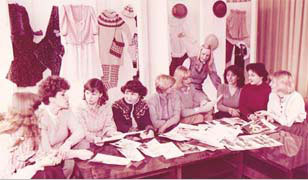
Creative moments, Jelena fifth from right
But even in socialism fashion designers were bending the rules for the Art’s sake. Catwalks - was the only time when ‘big bosses’ were loosening their strings, letting artists burst out with the frenzy ideas.
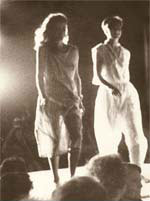
1979 Catwalk
“We could sometimes choose totally unbearable fabrics, but very spectacular on the catwalk. We knew that these [fabrics] could easily crease, fade and collapse,” said Jelena.
Hungry for anything new and expressive, show goers would purchase these garments directly from the experimental collection. Jelena “We would always acknowledge the customer about the textile quality and would warn about possible consequences of it- fading, creasing or something else.”
But the once obtained knowledge of what is a truly good-quality fabrics troubles Jelena, as even pure linen or cotton, these days does not look as it is meant to.
“The main quality of organic and natural fibre like linen, cotton and hemp is that it is very heavy. It sits very well and drapes beautifully, and it does not happen to the modern textiles of a Western standard which is deemed to be better.”
She said that the quality has obviously dropped, and there are benchmark to compare with. “Consumer has become complacent with what is being offered.”
Ex-Soviets are only left with a hope for a better expansion of a slow come of organic materials in the Eastern block. But the only fabric, which has been massively promoted by fair-trade-like companies is cotton—which in Soviet Union was the cheapest textile. Due to its economic value, there still is a a memory of cotton being identification of misery and destitution in peoples' minds. Hence, eco-friendly organizations would probably need to think of a very convincing marketing idea in order to conquer the hearts of ex-Soviets. Otherwise they could suspect that Westerners want to buy them cheap.
Related articles:
Share