

|
what now? |
||
 |
|||
|---|---|---|---|
Whether the British graduate is in trouble is really a question that cannot be answered by any generalisation. Essentially, the graduate themselves is the only person that can suffiently analyse whether the path of higher education that they took is one that will steer them in the direction that they hoped. Some students can study a specialist degree with the hope of pursuing that specific career, and find that this was the best thing that they could have done. Others may choose a degree because it seems easy, and struggle to find work when they graduate. The so-called 'Mickey Mouse' degrees may not be a good way into a big investment bank, but the skills learned could be more useful in a specific career than any of the 'traditional' degrees. Some may find that their first degree alone gets them to their ideal job. Others may pursue a post-graduate qualification, because they do not think that their earlier achievements are enough. The two graduates below, Guy Norman and Andrew Rayner, both had what is deemed by many to be lacking in the pool of British graduates: good quality degrees from well-respected universities. Yet they both found that they had to take different paths in order to get the jobs that they wanted. |
|||
| Guy achieved a 2:1 in Geography from the University of Birmingham. He found that he needed a MA to get ahead in the competitive jobs market.
|
Andrew achieved a 2:1 in Engineering from the University of Birmingham. He managed to secure a job at Proctor and Gamble.
|
||
 |
 |
||
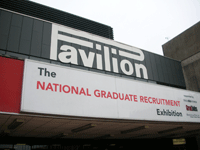
Talking to graduate's 'shopping' for jobs at the National Graduate Recruitment fair in Birmingham, optimism about employment seemed to be high.
|
|||
|
|||
The path that any graduate chooses depends entirely on what they want from their career. Many are finding that studying a post-graduate qualification is a useful endeavour in the hunt for a job. Others may be happy with their first degree. But the people entering higher education must understand when they embark upon their studies that the process is not a cheap one. The decision that they make must be one that has taken serious consideration - as student debts are reaching unprecedented levels, each potential graduate must know that their choice is worth the money that they will spend. It is perhaps far to general to say that British graduates as a whole are in a state of crisis. But graduates who find themselves with a degree that they didn't want, because it was the easy way or the fun way, almost certainly will be. |
|||
