|
“Significantly improved or an “utter shambles”; the Prime Minister may have changed but has Gordon Brown inherited a workable asylum system?
Secretary of State for Innovation, Universities and Skills and former Home Office minister John Denham, claims that huge steps were taken during Tony Blair’s premiership:
“Ten years ago it was taking an average of two and a half years for somebody’s case to be determined.
“That is now down to two months so the system has got much faster, fairer and judgements are made more clearly".
Outside of the government, many politicians remain sceptical of asylum policy. Among those is former Liberal Democrat Home Affairs Spokesperson, Mark Oaten.
He is particularly critical of work permit conditions relating to pending asylum applications:
“I’ve never understood why the government isn’t more flexible about allowing those awaiting decisions to be able to work.
“That would be a policy that’s good for society and for the individual. I think policies have been harsh, not welcoming and frankly quite stupid in denying the opportunity for some asylum-seekers to be able to work.”
Although some applicants are granted work permits, many work illegally to supplement the basic support they receive from the state.
UKIP Leader Nigel Farage believes that the immigrant community has lead to a surplus labour market and feels that refugees and asylum-seekers have exacerbated the problem:
“We have a mass oversupply of labour, in particular unskilled labour. That’s leading to increased unemployment and social tensions in many of our towns.”
The European debate
Farage believes that Britain will have little chance to reverse any immigration or asylum trends whilst it is a member of the European Union:
“The great truth of all this is that if you’re in the EU you cannot have your own asylum policy.
“It is progressively done for us by the European institutions and we now have a situation of open borders allowing free movement which I think is wholly irresponsible.”
John Denham rejects this claim and believes the future of domestic asylum policy is firmly under the government’s control:
“Judgements made about who should be accepted as genuine refugees and who should not are set out in the Geneva Convention.”
Denham stressed that EU membership has no impact upon the Convention and insists that the UK government has complete control of applying law and policy.
Britain’s major political parties and asylum charities all agree on one thing: the asylum system is open to abuse and illegal immigration is a real issue.
Guy Richardson, a solicitor who spent 11 years working for the immigration service claims to have seen “only a handful of genuine asylum cases” throughout his time in that job.
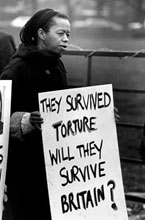 The most recent annual figures show that the Home Office awards status to less than ten percent of applicants. It’s how to deal with the vast majority whose applications fail that is the source of much debate.
Critics sight a lack of consistency between government departments, meaning that many people are left with the bleak prospect of returning to unsafe, unstable countries:
“There is a contradiction between the Foreign Office and the Home Office. On the one hand we are told that certain countries are unsafe and to be avoided", says Mark Oaten.
“At the same time if someone comes here to make an asylum claim they’re sent back because they are told the country is safe.”
Asylum in the future
Farage, Denham and Oaten all accept that there is a great deal of confusion in the way asylum is understood. This is particularly true when it comes to understanding benefit entitlements – an area which is often inaccurately commented upon in the media.
“Asylum is not just an excuse to be here, it’s a proper legal process aimed at those fleeing persecution,” says Denham.
“The basic principle is clear: if you don’t have a right to be here, you can’t expect tax payers to fund you continuing to stay.”
Though both Oaten and Farage anticipate some changes to asylum policy during Gordon Brown’s tenure at Number 10, Denham predicts that the following debate will continue:
“Everybody accepts there are a group of people who don’t have a right to status but whom have great difficulty returning home.
“I think in the future that will remain an issue of debate in public policy”.
Click below to hear more from John Denham, Mark Oaten and Nigel Farage
John Denham
Mark Oaten
Nigel Farage
|


