
Audio Stories  |
Breaking News |
Parallel Industries |
Blood Diamonds
|
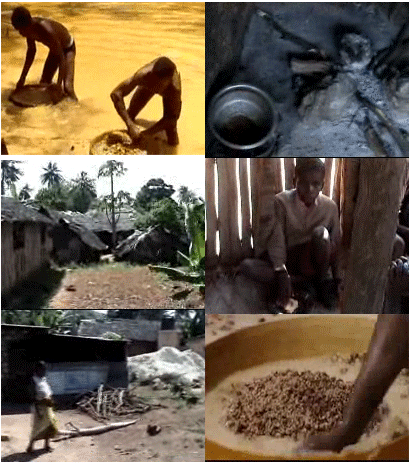
Blood Diamond Facts: Today, over 99% of the world's supply of diamonds is from sources free of conflict. Diamondfacts.org states the blood diamond facts. Fact #1: An estimated 5 million people have access to appropriate healthcare globally thanks to revenues from diamonds. Fact #2: Conflict diamonds have been reduced from approximately 4% to considerably less than 1% since the implementation of the Kimberley Process in 2003. Fact #3: An estimated 10 million people globally are directly or indirectly supported by the diamond industry. Fact #4: The diamond mining industry generates over 40% of Namibia's annual export earnings. |
Conflict Diamonds
“Diamonds that originate from areas controlled by forces or factions opposed to legitimate and internationally recognized governments and are used to fund military action in opposition to those governments, or in contravention of the decisions of the Security Council.”
- United Nationals definition of conflict diamonds
What are Conflict Diamonds?
Conflict diamonds sometimes referred to as "blood diamonds" are diamonds illegally traded to fund conflict in war-torn areas, particularly in central and western Africa.
Background
Conflict diamonds captured the world's attention during the extremely brutal conflict in Sierra Leone in the late 1990s. During this time, conflict diamonds represented approximately 4% of the world's diamond production. Illicit rough diamonds have also been used by rebels to fund conflicts in Angola, Liberia, Ivory Coast, the Democratic Republic of Congo and the Republic of Congo (also known as Congo Brazzaville).
Although the flow of conflict diamonds has been reduced to less than 1%, there are still some African diamond-producing countries – Ivory Coast and Liberia – that are under UN Security Council Resolution to prohibit the extraction and trade in diamonds. The Republic of Congo does not meet the requirements of the Kimberley Process owing to areas of non-compliance and was expelled in July 2004. Despite both the Republic of Congo and Liberia benefiting from internationally recognized peace agreements, diamonds from these countries may be referred to as "conflict diamonds". These countries produce a very low percentage of the world's diamond supply.
What is being done?
In July 2000, the global diamond industry made clear to the international community its zero tolerance policy towards conflict diamonds. Dedicated to eradicating the trade in conflict diamonds, it worked closely with the United Nations, governments and non-governmental organizations (NGOs) such as Global Witness and Partnership Africa Canada to create the Kimberley Process Certification System. This system was formally adopted in 2003 and guards against conflict diamonds entering the legitimate diamond supply chain. The diamond industry also adopted a voluntary System of Warranties to assure consumers that their diamonds are from sources free of conflict.
Today 71 governments have enshrined into their national law the Kimberley Process Certification System, and now more than 99% of the world's diamonds are from conflict free sources. However, even one conflict diamond is one too many. The diamond industry continues to work with governments, NGOs and the UN to strengthen the Kimberley Process and the System of Warranties.
While diamonds have been used to fund conflict, the problem is not the diamonds themselves but the rebels who exploit diamonds (along with other natural resources) to achieve their illicit goals. The vast majority of diamonds come from countries at peace. These countries have been able to invest the revenue from diamonds into the development of infrastructure, schools and hospitals for the good of the communities in which diamonds are found. These countries include Australia, Botswana, Canada, Namibia, Russia, South Africa and Tanzania.
What is Kimberley Process?
In May 2000, responding to a growing grassroots movement on "blood diamonds," governments and the diamond industry came together in the South African town of Kimberley to combat the trade in diamonds from conflict zones. The result of these negotiations was the Kimberley Process Certification Scheme, setting up an internationally recognized certification system for rough diamonds and establishing national import/export standards. In November 2002, 52 governments ratified and adopted the Kimberley Process Certification Scheme, which was fully implemented in August 2003.
The Kimberley Process Certificate
It’s a self regulatory process.
Participants understand that a voluntary system of industry self-regulation, as referred to in the Preamble of this Document, will provide for a system of warranties underpinned through verification by independent auditors of individual companies and supported by internal penalties set by industry, which will help to facilitate the full traceability of rough diamond transactions by government authorities.
Each Participant should ensure that:
(a) A Kimberley Process Certificate (hereafter referred to as the Certificate) accompanies each shipment of rough diamonds on export;
(b) Its processes for issuing Certificates meet the minimum standards of the Kimberley Process
(c) As long as these requirements are met, Participants may at their discretion establish additional characteristics for their own Certificates, for example their form, additional data or security elements.
Draw Backs
The Kimberley Process was seriously flawed from the beginning. The Kimberley system of "voluntary self-regulation" on the part of the diamond industry has meant a significant lack of transparency and independent monitoring efforts. The World Diamond Council, initially established to represent the diamond industry at the Kimberley Process, has failed to coordinate effective industry monitoring. Governments, too, have been uninterested in monitoring and regulating the diamond trade. Some say the Kimberley Process amounted to little more than a public relations stunt for the diamond industry, and recent reports by Global Witness and other NGOs have found little evidence of genuine attempts to deliver on industry commitments.
Fact #5: Diamond revenues enable every child in Botswana to receive free education up to the age of 13. Fact #6: In July 2000, the global diamond industry announced its zero-tolerance policy towards conflict diamonds and continues to drive this policy. Fact #7: Sierra Leone is now at peace and exported approximately $142 million diamonds in 2005. Fact #8: Approximately one million people are employed by the diamond industry in India. Fact #9: Approximately $8.4 billion worth of diamonds a year come from African countries. Fact #10: More than 99% of diamonds are now from conflict free sources and traded under the UN-mandated Kimberley Process. Fact #11: The Diamond Development Initiative was established to improve the working conditions of artisanal miners. Fact #12: The revenue from diamonds is instrumental in the fight against the HIV/AIDS pandemic. Fact #13: Under the Kimberley Process, rough diamonds can only be exported and imported when accompanied by a certificate from the exporting country. Fact #14: The charity Jewelers for Children funds a community based care program for orphaned children in South Africa. Fact #15: An estimated 65% of the world's diamonds come from African countries. Fact #16: Today, 71 governments and the legitimate diamond industry are all committed and legally bound to eradicating conflict diamonds. Fact #17: The diamond industry has introduced a system to help give greater assurances to retailers and to provide consumers with the reassurance that their diamond is from a conflict free source. Fact #18: Diamonds account for 33% of the GDP (approximately $3 billion) of Botswana. Since diamonds were discovered in Botswana, GDP annual growth rate has averaged 7%. Fact #19: Major world leaders - including Nelson Mandela - have cited the importance of diamonds to the lives of African people. Fact #20: It is estimated that one million people work in the informal (astisanal) alluvial diamond digging sector. Fact #21: Some diamond producing countries are not Kimberley Process compliant. Fact #22: In November, 2006, 71 Governments, leading NGOs, and the World Diamond Council agreed on measures to further strengthen the Kimberley Process. Fact #23: At the 2006 Kimberley Process Plenary, the industry committed funds and resources to address challenges faced by countries with a high prevalence of artisanal alluvial mining. |