 |

The rise and fall of the school meals service
The story of school meals is closely linked with the rise of the public services and the creation of the welfare state in England and Wales.
1879 - Manchester starts free school meal service to combat poor health of children. Alongside Bradford, leaders campaigned for more cities to follow.
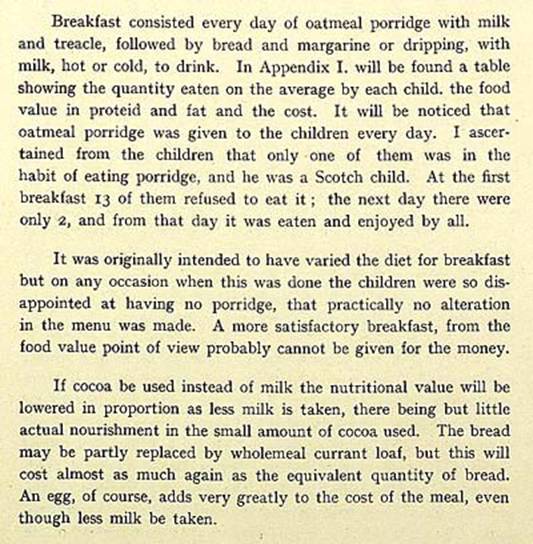
(Taken from City of Bradford Education Committee Report by the Medical Superintendent, Ralph H Crowley M.D., M.R.C.P. in conjunction with the Superintendent of Domestic Subjects, Marian E. Cuff, on a Course of Meals given to Necessitous Children from April to July, 1907)
Click on image to enlarge
1906 - Local authorities given go-ahead to offer meal service but not compulsory.
1921 - The miners strike puts pay to plans for a free school meal service. Number of meals taken rises to one million.
1924 - Free school milk is introduced.
1940 - National school meals policy introduced with the government providing 70% of the cost initially, rising to 95% in 1941.
1944 - ‘Universal’ welfare state takes shape and provides meal to any child that wants one.
1947 - National school meal price set and rises about cost of raw ingredients for first time.
1964 - Milk provision stopped for secondary pupils, primary follows in 1971.
1979 - Prime minister Margaret Thatcher introduces massive cuts in meal budget. Price of meal rises 250% in decade to 30p.
1980 - LEAs given power to axe school meal provision. Dorset County Council swaps kitchens for classrooms.
1988 - Introduction of private companies sees fixed national price abolished, profit schemes such as vending machines.
2002 - NHS opens first clinic to deal with childhood obesity.
2005 - Government announces interim package of £280 million to tackle the problem. School Food Trust set up to provide expert advice. Competition forces production costs to drop to 36p in some areas.
2006 - New rules for school meals introduced allowing provision for hot meals that includes at least two portions of fruit and vegetables a day.
2007 - War on junk food reaches all food in school including vending machines, tuck shops and clubs.
2008 - Nutrient based guidelines take effect. Optional cooking lessons return to secondary school.
Information on this page collated from my own research and McMahon W and Marsh T (1999) Filling the Gap: free school meals, nutrition and poverty. Child Poverty Action Group: London