 |
|
|
|
|
|
|
 |
|
|||||
 |
 |
 |
 |
 |
 |
|
|
book review The sourcer’s apprentice
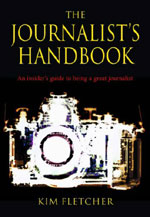
It’s perhaps deliberate that Kim Fletcher named his journalism handbook to give the impression that only one person is meant to read it. To some degree the journalist is a solitary figure, and as Fletcher’s no-nonsense advisory style to the aspiring hack intimates, it’s you against the world. So get used to it.
It’s a fact that Fletcher is an old boy from journalism’s old school, but that hasn’t stopped him from recognising the attributes of the new. So if you’ve ever questioned whether journalism degrees are worth the paper they’re printed on, hop straight to page 35 for the answer. Old sweats, he says, sneer at these. It’s good to see this old sweat doesn’t see himself as one. Although there’s no escaping such courses these days, he adds, the skills they teach young journalists mean that when they do enter the profession, they should be equipped to contribute straight away. Now that you’re fairly sure that your journalism qualification is worthy of today’s media, you’d better prove there’s some value to the few grand you invested in your education. But in order to contribute, the wannabe hack needs a way of ‘getting in’. Thankfully, this is explained in Chapter 3 of the same name. However, ‘Getting On’ in journalism (Chapter 4), is something else entirely, as Fletcher is only too quick to point out. Not bothering to find out if the unisex name, Kim, belongs to a man or woman, for instance, will result in basketball practice with your letter and the waste paper basket. It’s this kind of solid advice that the author does best. What he doesn’t do so well are his Dos and Don’ts of journalism. These rough diamonds, plucked from editors and journalists from titles like Observer to Glamour magazine, could have shone more brightly if only they had been compacted into a comprehensive list. Some of the points, for example, about being precious about one’s copy before it goes to the sub-editors, are repeated. It’s a fact that ironically begs subbing. There are similar gripes to be had with the seemingly indiscriminately placed sections, ‘My Big Break’ and ‘Dream On’. Not only do they float like non-contextualised voxpops, but they are mostly composed of the same sources who dished out the Dos and Don’ts. These industry tales are entertaining asides, certainly, but it seems they were included for reasons known only to the author. Similarly, the chapter on practical writing could have been more practical; using subsections to aid assimilation of the great tips contained within would have no doubt helped. But enough advice for Fletcher. He does have plenty of his own, including some neat methods of tightening up your news language. Slack, dishonest and unenergetic journalists, he counsels, will invariably be caught out by the language they choose. Phrases such as ‘up to’, ‘set to’, ‘it was claimed last night’ and words like ‘plans’ may be best laid, but they’re laid on shaky journalistic foundations – and are best avoided. Given such advice in news writing, you’d be forgiven for thinking The Journalist’s Handbook was written only with young regional newspaper talent in mind. Not so: the freelancer, which essentially everyone is to start with, gets an informational leg-up too. A journalist is an everyman. You’re a salesman making a pitch. And if you don’t pitch right – in that you write political tomes rather than brisk comment pieces, or you write about a rock star falling into a vat of formaldehyde when there was a Rolling Stones review in the paper yesterday – the editor will strike you out. However, if you’re overflowing with ideas during journalism’s low season parched August, intimates Fletcher, you’ll be off for after-work drinks with the Ed. This is something to take note of, then transcribe and keep tucked away. You’ll be glad you did when an angry mother, whose sword-like slap is mightier than your pen, takes issue with your piece about her alleged cathouse activities (paraphrasing). The second half of the guide moves away from the target reader’s immediate concerns with getting in and getting paid, to offer advice on the crucial issue of law. Set up predictably against the backdrop of the David Kelly affair, ethics and real-life hypotheticals are given sound treatment. In addition, the virtues of online versus print journalism and the evolution of broadsheets into ‘compacts’ form welcome, up-to-speed mini-debates – each of which are held together by the NCTJ Chairman’s colourful anecdotes and insider knowledge. Indeed, privileged information is the selling point of The Journalist’s Handbook. In a way, it’s a shame there isn’t more of it. But you’re a journalist. You’re meant to source information. It’s not a word (yet), but you’re a sourcer. By reading Fletcher’s immensely readable, authoritative, informative and witty guide, you’ve become the sourcer’s apprentice. The Journalist’s Handbook is by no means exhaustive. But it’s a start, and this is exactly what a new journalist in the industry needs. As Fletcher says, the most encouraging thing about the newspaper business is that “there are more writers than you think it can possibly want. But there is always room for another good one.” That’s good advice. |
related links The Daily Telegraph online: You do it even if they didn't pay you |
 Such
firm, but fair, advice could only come from the recently let go
editorial director of the Telegraph group and well-travelled Fleet
Street high flyer, who has worked for both the The Sunday Times
and Sunday Telegraph and who has edited The Independent on Sunday.