Going inside
Prisoners are a reading risk group. In 2006 the Learning and Skills Council (LSC) took responsibility for offender learning via Olass. This project should ensure that prisoners have access to learning in order to gain the skills and qualifications they need to enter employment.
Criminologists and sociologists underlined the correlation between crime and functional illiteracy at the turn of the century. In 2004 a debate in the House of Lords revealed that 50 per cent of prisoners lack basic reading skills.
As a result the educational charity Safe Ground got together with HM Prison Service and the LSC and produced two pioneering courses: 'Family Man' and 'Fathers Inside'. Over 800 prisoners and staff from 14 prisons have been involved in those.
The courses use drama, fiction and group work, and they are accredited. All resources have been designed in consultation with prisoners, as the concept originated from inmates at HMP Wandsworth who wanted a learning experience that could help them to find constructive ways of preventing their children from engaging in criminal behaviour.
Other prison projects are ‘The Big Book Share’ which encourages inmates to share books with their children or the ‘Storybook Dads’ which enables prisoners to record themselves reading stories for their children.
Read in the premier league
Make books short and easy to read, get footballers involved and bring some drama into prisons: this way the boys and men are ‘booked’.
"I didn't want my children to go through the same experiences as me, going to the bedroom at night and crying because they were different to everyone else. I struggled at school – it was a frustrating time. If you are called lazy and stupid often enough your start to believe it.”
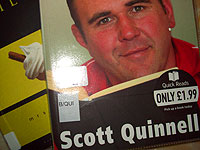
Thus Scott Quinnell, ex rugby star, launched this year’s ‘Quick Reads’ campaign. He has published a book entitled ‘The hardest test’. In it he describes what it was like to be a functional illiterate.
‘Quick Reads’ are short books by bestselling writers and celebrities for adults who are new to reading or have lost the reading habit. The books use limited vocabulary and large print. They are available from libraries, supermarkets, bookshops and online at just £1.99.
Adult learners have voted Adele Parks’ ‘Happy Families’ their favourite title of 2008. In the top list figures the latest ‘Doctor Who’ book next to ‘The 10 Keys to Success’ by John Bird. Other favourite authors are Colin Jackson, Gordon Ramsey, Maeve Binchy, Richard Branson or Ricky Tomlinson. The campaign is in its third year and a major collaboration between authors, publishers, government bodies and many more.
Everybody involved in adult learning praises ‘Quick Reads’. Jenny Oliver, reading and learning librarian at Poole Library, says: “They are extremely successful for the learners and us, we bought loads of copies and have high borrowings. The first ones were mainly aimed at men, because the campaigners held that was a large part of the market, but the later ones address everybody, there is quite a range now: life-stories, thrillers, romance, ghost and travel stories, how to succeed type books.”
Be a champion
It is indeed regarded as vital that boys and men succeed – in reading. The National Literacy Trust states that they read less and not as well as girls and women, and consider reading as feminine. So what a better way to get males hooked than via sports.
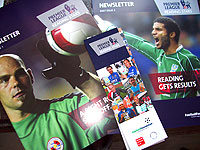
One of the most “striking” campaigns is called the ‘Reading Champions’. The reading champions are Premier League footballers or other well-known sportsmen who promote reading and their favourite books. “The campaign has been really successful. We have over 2000 signed up to it,” says Nick Batty, project coordinator at the National Literacy Trust.
Safe bets as reading champions are goalkeepers. David James (Portsmouth) for example has appeared in all six seasons. He chose Glenn Murphy’s book ‘Why is Snot Green?’ for this year’s campaign. Beside him figure Edwin Van Der Sar (Manchester United), Manuel Almunia (Arsenal), Scott Carson (Aston Villa), Ricardo Carvalho (Chelsea) or Michael Ball ( Manchester City ). Sir David Richards, Chairman of the Premier League, says in the newest brochure promoting the campaign that it gives players the opportunity to act as positive role models and shows that by using the power of football people’s attitudes to reading can successfully be changed.
Many clubs’ involvement go even further. 77 sports clubs have opened their own study centres, in connection with an initiative called ‘Playing for Success’ which is funded by the government with about £10 million per year. All the centres’ activities are based on football or rugby; matchday programmes for example serve as reading material. Ed Balls, Secretary of State for Children, Schools and Families, says on the campaign’s homepage that the work of those centres corresponds with the government’s vision of the future of learning: personalised around the needs of every child.


