Developer down
What problems hit one of the UK's most famous developers, Free Radical, and could the tax breaks have saved it?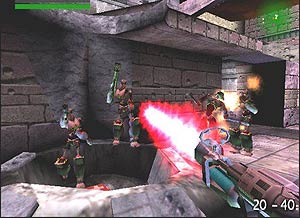
The last few years haven’t been kind to the games industry especially in the UK. When the recession hit a lot of development studios closed down due to investors pulling out and tentative deals being withdrawn. Unfortunately this lead to the loss of one of Britain’s most loved development studios, Free Radical. To the uninitiated the name mightn’t mean much but to those that played its games through several generations of consoles then Free Radical was one of the greats when it came to game design.
Free Radical was set up in 1999 after David Doak, Steve Ellis, Karl Hilton, Graeme Norgate and Lee Ray left another favourite developer of the UK gaming scene, Rare, and decided to set up their own company. Previously the team worked on the genre defining GoldenEye on the Nintendo 64, a game that regularly takes a top ten spot in any Best
Games Ever list as well as its spiritual successor Perfect Dark. 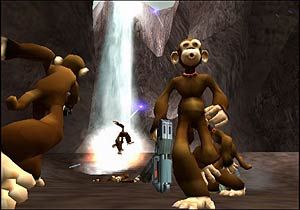
The team’s first game as Free Radical was the astounding Timesplitters on the PS2 which retained the intuitive first person shooter aspects of GoldenEye and Perfect Dark but refined them into a new IP with incredibly smooth gameplay that became the hallmark of the series. It also introduced the concept of the time travelling aliens and included a superb sense of humour that can be described as ‘British’. The only thing it lacked was a cohesive single player mode, but the split screen four-player (including bots!) more than made up for this. And again the team had managed to make one of that generation’s classic games.
A sequel, cunningly titled Timesplitters 2, was released on all the major consoles in 2002 with an expanded single player campaign as well as the now familiar but updated multiplayer. Again it was critical and commercial success and
beloved by everyone who played it. 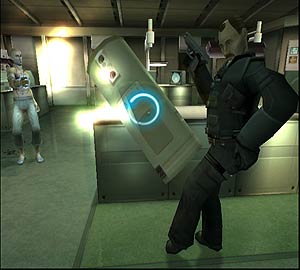
The next game to come out of Free Radical was the mind bending third person action adventure game Second Sight. Released in 2004 towards the end of the PS2, GameCube and Xbox’s life cycles it didn’t perform as well as hoped in the charts.
Managing director at Crytek UK (sorry, this article doesn’t have the happiest of endings) Karl Hilton explains what happened: “Second Sight was originally the game we set out to make when we set Free Radical up. We were incredibly proud of that game – the narrative in it was, I think, one of the best of its time. In terms of the quality of what we did it was outstanding, but we didn’t actually get much penetration in the market with it. In terms of sales it was a bit of a disappointment. Ironically now it pops up on websites of people doing retro reviews saying how good it was,” making perhaps one of the ultimate slow burners in the gaming history.
Timesplitters: Future Perfect followed but something felt a little off about it. It was published by Electronic Arts which was suffering from a critical backlash as it was seen as it was buying up studios and forcing them to include certain aspects in the games that, in order to give them a broader appeal, generally made the games feel dumbed down and very Americanised. 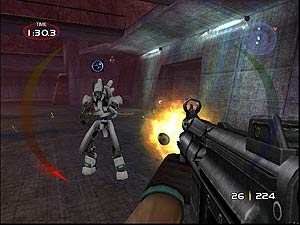
Karl recalls: “EA Partners published that game because they’d seen Timesplitters 2 and seemed very impressed with that and they were very interested in a third one. They pushed us to put more single player into it, which we did. The title did quite well but it didn’t do as well as the second title did for some reason, I’m not sure why.”
That was Free Radical’s last game on the last generation of consoles. With the new generation, the Xbox 360, PlayStation 3 and the Wii, people expected a new Timesplitters game, one that made use of the much improved graphical power and processing speeds of the new consoles. But Free Radical wasn’t about to go down the safe road and release another sequel. Instead it announced Haze.
Yes it was another first person shooter but it had very interesting gimmicks and an incredibly strong storyline that had you questioning your motives for your actions within the game.
Unfortunately there were problems as Karl explains: “The main problem we had with the project was that it changed a lot. Ubisoft was the publisher and they had a very strong editorial team that had some very strong ideas about what they wanted to see in the game. But it changed from the game we originally proposed to the game we ended up making, it went through a lot of changes. One of the biggest changes was that originally it started out as a PC project that we would eventually move to the consoles but it ended up being a purely PS3 project, partly because of a deal that was done.” 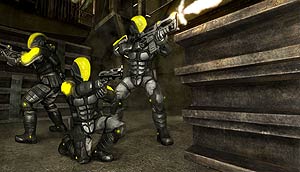
At this point in 2008 the PS3 hadn’t been out for just over a year and it was becoming notorious as a difficult console to code for. Even this year the developers of Bayonetta were having trouble matching the Xbox 360 version of the game with the PS3 version. Some of the quality issues Free Radical had with that really hurt the overall feel of the game and people were disappointed. Consequently Haze was criticised heavily and it never went on to sell as much as it could have done had it been released as a multiformat title.
“Haze didn’t have the sales that we needed it to have and in terms of us as a company we didn’t make much money on that product in terms of its sales and royalties. Sales of Haze was not what caused Free Radial to go wrong at least not from a financial point of view, but obviously you’re only ever as good as your last product, so when we had Timespltters 1 and 2 people were very impressed, but when you go in and your last game was Haze you’ve got a bit more of an issue on your hands,” recalls Karl. 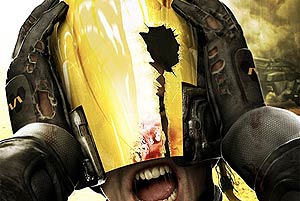
During the development of Haze Free Radical employed over 200 people and the company had a couple of contracts with various publishers. “They were going very well," explains Karl, “but then they decided to terminate the contracts one at a time, not in a way that we felt was fair but that was that. You can get involved in legal fights if you want to but that’s a very expensive and long term thing so you try and handle it as best you can.
“That was just as the credit crunch was hitting and everyone was tightening their belts and everyone was very nervous about what was happening with spending, and the banks weren’t lending anymore... publishers often rely on credit lines to fund new projects.
“Obviously with the size of Free Radical at that time our monthly rate on what we spent on salaries was very high and although we had a decent amount of reserves you can only go for so long. We spoke to a lot of publishers but ultimately we just weren’t able to get another contract in place in time to continue running the company and we ended up having to put it into administration.
“For us it was very critical that we didn’t continue to run the company on promises to people so as soon as we thought it wasn’t viable to get a deal on time we wanted to makes that we didn’t leave our staff out of pocket. You hear a lot about dev companies going down and then people haven’t been paid for a long time – we didn’t want to do that as we had far too much respect for our staff.”
After going into administration Free Radical was down to about 40 key staff and then offers started coming in to buy the company. German developers Crytek (Far Cry, Crysis, Crysis 2) was one of the companies interested and were very keen to have a UK base as it was expanding a lot and they wanted one because of the: “talent and skill base they know is here so we were quite well timed for them, and so the deal was done,” says Karl. 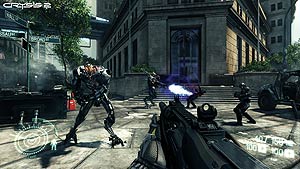
As we know now the tax breaks for video games aren’t going ahead. It’s left a lot of developers disappointed but in this case would the tax breaks have been able to save Free Radical had they been introduced around that time?
Karl says: “Probably not.” Oh.
“The video games industry is very healthy overall, the problem we’ve got at the moment is that other countries use them and it’s not a level playing field. So it’s hard to compete with Canada when it’s offering the sort of subsidies that they are and that’s why we support tax breaks in the UK and Crytek certainly supports Tiga and its campaign to get them.
“The problem for Free Radical was the credit crunch really and the loss of our contracts and the difficulty of signing up new contracts and tax credits wouldn’t necessarily help with that. Although you could argue that if the UK had a wonderful tax regime that when things get tight publishers would focus their money in areas where they’d get value for it so they might come to the UK. 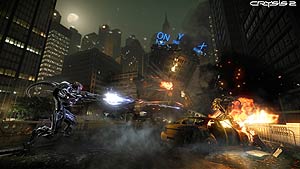
“As far as I’m aware Canada didn’t suffer too much during that period because it is an efficient place to make a video game. In the long term having competitive tax environment is always going to be good for business and if you can set yourself up as a long term good place to make video games then that’s going to stand you good stead. “I’d rather Canada and France just stopped doing it but we need to compete with them so we do need tax breaks to make it level.”
So while the tax breaks mightn’t have saved Free Radical had they been introduced there could have been some outside investment made and perhaps the contracts they were seeking would have been more forthcoming. And if that happened then maybe we would, by now, have Timesplitters 4. And one can only dream what would that would have been like on this next generation of consoles.