Ownership - a key issue
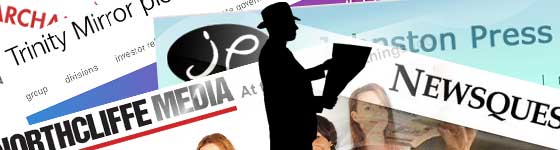
The top 20 publishers in the UK account for 88.8% of all regional and local newspaper titles in the UK, according to the Newspaper Society.
These companies have invested heavily to purchase established newspaper brands and media throughout the UK.
Former managing director for Newsquest in North and East London Dan Mason says the quest to satisfy shareholders has overtaken the need to maintain journalistic standards.
 Newspaper circulations are falling
"In the regional press in the UK it has gone from being a country of locally owned newspaper groups to a series of a very few shareholder driven, large newspapers groups," he said. "The fundamental difficulty is with the large groups who are driven by shareholders. So, they have no choice but to drive shareholder value at the same time as revenues are plummeting.
"Profit and, to put it another way, greed has been a very important part of causing the problems that we are now in. It's not the only cause by all means; however, when you are comparing any business the newspaper industry has been incredibly profitable.
"It is an absolute crisis. In the large newspaper groups some share prices have fallen by more than 90% in the last year and they're in a very difficult position."
"Knee-jerk reaction"
Mr Mason, who worked with the Evening Mail in Birmingham, believes media companies have been too quick to axe journalistic jobs.
"The knee-jerk reaction among the large groups has been to reduce the levels of journalists and indeed advertising staff.
"How can you build a business that is based on the value of local information when you are less able than ever before to provide that service to local communities?"
Lecturer in journalism at the University of Sunderland Alex Lockwood agrees.
"The drive for profit has really impacted on newsrooms even more than the rise of the internet," he said.
"We're living in an economy and zeitgeist that only pushes increased growth as the barometer rather than profit itself and that's been a big problem.
"Most publishing companies are still making profit. They're just not making the greedy amounts they want to make that they might have made ten to twenty years ago."
Southern Daily Echo editor Ian Murray says large news groups can be also be beneficial for the industry because, as long as they support staff training, there is "strength in numbers" with these companies.
Strike
Joint father of the National Union of Journalists (NUJ) chapel at the Yorkshire Evening Post Peter Lazenby has been involved in strike action against his employer, Johnston Press. Staff at the Yorkshire Evening Post and Yorkshire Post went on strike for 13 days in 2009. Mr Lazenby believes large media companies will have to settle for smaller profit margins in the future.
"The employers have got to get used to lower profits. They can no longer expect a return of 30% on turnover. They're going to have to accept 10-12%," he said.
The costs of publishing and running a newspaper are high but other models separate from large media companies are emerging. Read>>>