


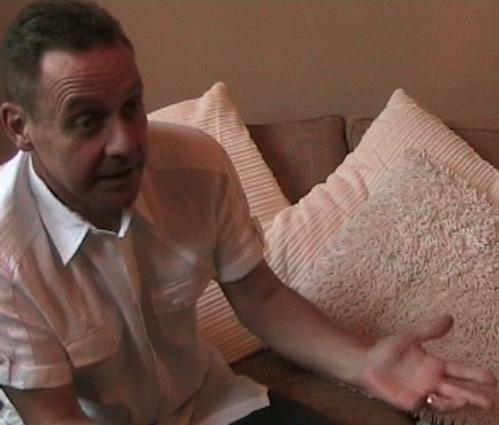
 Danny West is a 48-year-old from the South East of London, who has been living with HIV for nearly 25 years. He was one of the first people to be diagnosed with HIV when the epidemic broke out in the UK in October 1985. He recalls how traumatic it was back then: “I was completely horrified,” he says.
Like many other HIV positive, Danny admits that the UK is the best place to live with this condition because of the drugs available free of charge from most public’s health organisations.
Although Danny says that he made up his mind from the beginning that he would never hide the news from his family, he confesses that life has not been always been that easy for him. When he announced to his parents that he was gay as a teenager, he lost contact with his dad who refused to accept him that way. Then when was diagnosed, his dad still didn’t want anything to do with him. However, over the years, Danny has learned to tighten up his belt and find a way to enjoy his life having a supportive circle of friends and family.
“I guess I developed a way of coping as a result of being gay. …Very soon after being diagnosed, I got involved in some of the very early HIV organisations here in the UK. Organisations such as Body Positive, London Light House and the Terrence Higgins Trust. Yes it was very much seen as a death sentence and the majority of my friends in my community died of HIV in those days,” says Danny who is now running his own counselling company, RY Consultancy, motivating and training HIV positive people in the UK and pioneering the cause of HIV throughout Europe and India.
First reaction to his diagnosis: play
Q&A
Did you have the courage to tell your family? “I have never felt ashamed from being HIV positive or felt like I needed to be secretive about it. I’ve always felt that I had to live with a level of integrity about my HIV status. So one of the things I did quite early was to tell my family and my closest friends about my diagnosis.”
How did you contract it? “I contracted it sexually. I don’t know who I contracted from, and that actually isn’t important to me.”
Did you have to deal with anger? “Yes, I was very angry, but what I was and remain angry about now is the discrimination and the stigma that is associated with HIV, and the way people are mistreated because there are living with what is only a virus. I am very passionate about justice and I have seen a lot of injustice go on around the world and in this country among my community.
Why do you feel the need to do what you are doing today? “I think the stigma is very real. I think it is very much still alive. I think there isn’t any other disease or virus or health condition that is responded to in this way and has a stigma attached to it in this way. That is why I do what I do.
“A lot need to be done to begin to challenge the stigma associated with HIV. It’s probably twenty odd years since we’ve had a government’s health campaign around HIV and AIDS, and in fact all that did was to instil more fear into people.
“If you instil fear into people, people would not take in information. And I think genuinely out there, there is a very high level of misinformation and ignorance about HIV, which leads to the stigma and leads to discrimination,” says Danny who has also been a victim of discrimination. He has had a mortgage’s application turned down and has been denied access to enter some countries because of his HIV status.